
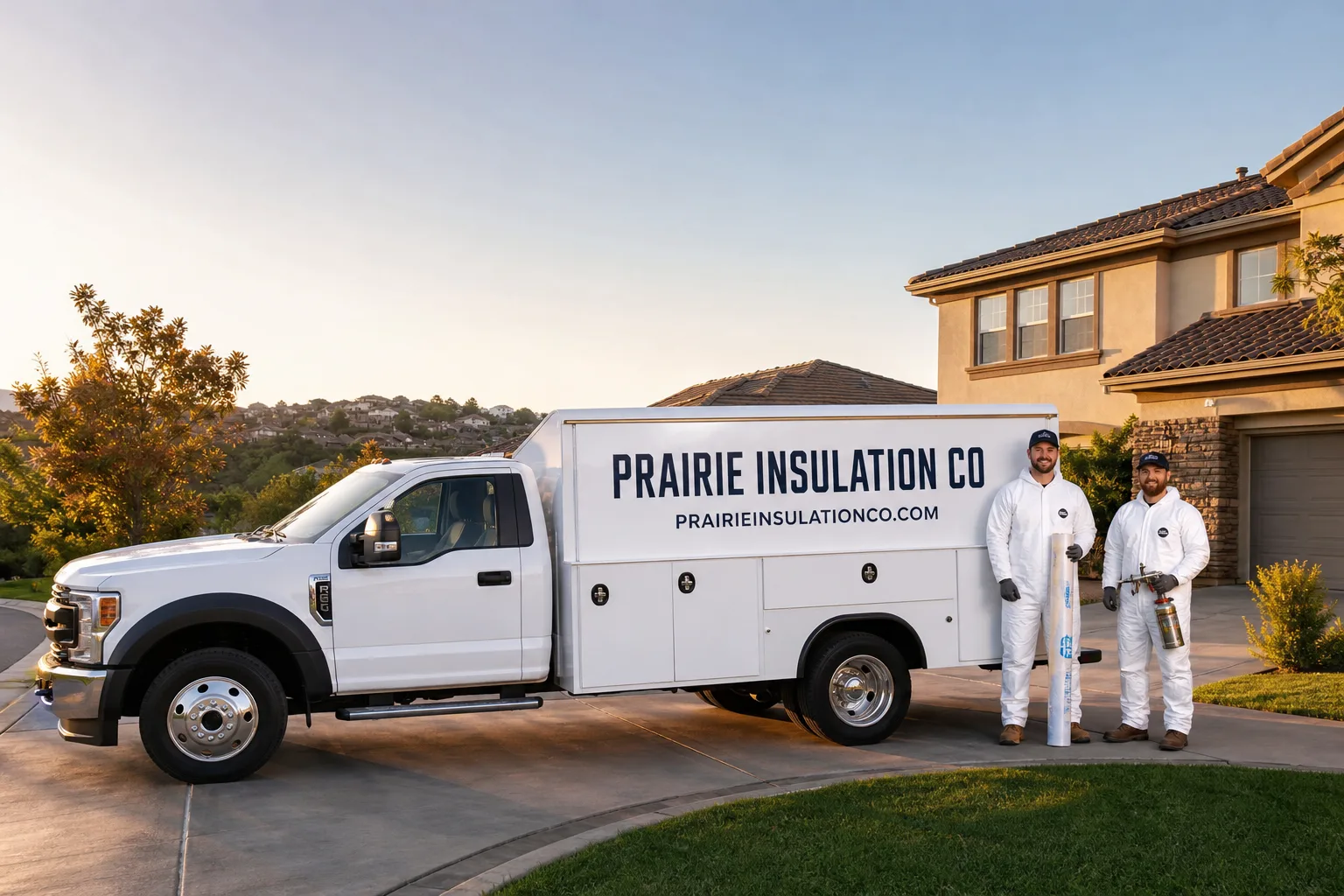
Fast, Reliable Spray Foam Insulation Across Portola Hills
Spray foam insulation in Portola Hills costs $2.40 to $5.10 per board foot for open-cell and $3.90 to $7.20 per board foot for closed-cell, with most whole-attic jobs running $4,800 to $11,500 depending on square footage. We run crews into Portola Hills from our Ladera Ranch shop five days a week, usually within 2 to 3 business days of your call. Most homes here were built in the 1980s and early 1990s, which means the original batt insulation has settled, slumped, or been pulled aside by decades of remodels, and spray foam is the fix that finally seals the gaps. Call Ken and the crew at (855) 219-0368 for a free estimate and we’ll tell you exactly what your attic needs.
Why Prairie Insulation Co Is Portola Hills’s Preferred Spray Foam Insulation Company
Portola Hills isn’t a one-product town, and we aren’t a one-brand installer. When a 1985 Spanish-style tract home off Saddleback Ranch Road needs its attic deck sealed, the right call might be an open-cell Icynene fill. When a two-story stucco house backing up to the Whiting Ranch foothills has rim joist air leaks, closed-cell Demilec makes more sense. We stock and install products from eight manufacturers, so we match foam chemistry to what’s actually happening in your house, not to what we have left on the truck.
Our familiarity with Portola Hills construction patterns matters. The 92610 ZIP is dominated by wood-frame, stucco-and-tile homes with shallow attic spaces. We know where the original batts fail first, where the can lights get buried, and where the south-facing tile deck fights back. That local knowledge means we show up knowing what to look at, not figuring it out as we go. Ken Sobecki started this company to be the advisor homeowners call when they want a straight answer about insulation, and that’s the role we fill in Portola Hills.
We quote response times honestly. For most Portola Hills homes, we can have a crew on site within 2 to 3 business days. Garages and crawl spaces often go faster because they’re smaller, contained jobs. Call (855) 219-0368 and we’ll give you a real window, not a vague promise.
Crawl Space Spray Foam Insulation in Portola Hills
Crawl Space Spray Foam Insulation in Portola Hills usually runs $3,200 to $6,800 for a standard 1,200 to 2,200 square-foot crawl area, and it’s one of the most overlooked fixes in the 92610 ZIP. The homes here sit on graded lots cut into the foothills, so many crawl spaces have open venting to the outside and bare dirt or thin plastic sheeting below. That means dry, hot air from the south-facing slope gets pulled up through the floor framing all summer. Spray foam applied to the crawl space walls and rim joists turns that dusty, draft-prone zone into a sealed buffer that stops hot air and canyon grit before it reaches your living space.
Why Rim Joists Matter Here
The rim joist is the horizontal band where your floor framing meets the foundation wall, and it’s wide open on most 1980s-build Portola Hills homes. Wind coming down off Whiting Ranch pushes dirt and heated air straight through those gaps. Closed-cell foam at the rim joist stops that movement at the source. We also watch for dust-caked openings where insulation was never installed behind the original construction.
Closed-Cell for Dry Heat
Portola Hills sits far enough inland that summer humidity stays low, but that dry heat is relentless. Closed-cell spray foam gives you a vapor barrier and an air barrier in one pass, which is the right choice when you’re sealing against hot, grit-laden air moving under the house. We’ll tell you honestly if open-cell would do the job for less; for most crawl spaces here, we specify closed-cell at the rim and open-cell on the walls.
Garage Spray Foam Insulation in Portola Hills
Garage Spray Foam Insulation in Portola Hills typically costs $1,900 to $4,600 depending on ceiling and wall coverage, and south-facing garages in this part of the 92610 ZIP need it more than most. The tract homes here were built with uninsulated garage ceilings and walls, and a garage on the hot side of the slope can hit 110 degrees or more in August. That radiated heat gets pushed through the firewall into your living area every time the door opens, and it soaks upward into any bedroom above the garage. Spray foam on the garage ceiling puts a physical stop to that heat transfer.
South-Facing Slope Heat Load
Homes built on the uphill side of Portola Hills get direct southern exposure all afternoon, and the garage door itself becomes a radiant panel. We see this constantly on streets climbing up from Glenn Ranch Road. Sealing the garage ceiling with closed-cell foam drops that surface temperature enough to notice in the room above, and it quiets the garage door opener racket too.
Attached Garage Air Sealing
Fumes, dust, and whatever’s in your garage shouldn’t leak into the house. The 1980s framing used simple fiberglass batts between the garage and living space, and those batts sag and pull away over four decades. We spray the ceiling deck and the shared wall cavities, sealing every penetration where electrical or plumbing passes through. That’s the difference between insulation that sits in the cavity and insulation that seals it.
Trusted Brands We Service in Portola Hills
We install and service spray foam systems from Icynene and Demilec, two of the most builder-specified foam lines in the industry, and we carry Johns Manville and Rockwool products for hybrid applications where foam alone isn’t the right call. Ken made a deliberate choice to stay material-agnostic. No single foam chemistry does everything well, and a Portola Hills attic that needs open-cell for sound control might need closed-cell at the rim joist for moisture resistance. We keep the products on hand to do both correctly and tell you why we’re specifying one over the other.
Common Spray Foam Insulation Problems We See in Portola Hills Homes
- Original batts pulled aside and never reset: Decades of remodels around Whiting Ranch Road left original fiberglass batts shoved away from can lights and HVAC drops. Canyon winds then push hot air and fine grit through those gaps. The fix is air-sealing the opening before foam goes in.
- Foam applied over compacted cellulose: Some homeowners paid for foam before, but the installer sprayed over settled early cellulose or slumping batts without removal. The foam lifts or debonds from the contaminated deck within a few seasons. We remove the old layer first when the deck is compromised.
- Shallow tile-roof attics: The Mediterranean-style homes here have tile roofs with narrow gaps above the attic deck. Edge coverage at wall plates often gets skipped because it’s slow, cramped work. That leaves a radiant heat path from the tile deck straight into the ceiling framing.
- Unsealed wall plates: The point where framing meets drywall is a leak path on nearly every 1980s-era Portola Hills home. Canyon wind pressure tests that seam constantly. Closed-cell foam at the wall plates is the single highest-value air sealing move for these homes.
Pricing for Spray Foam Insulation in Portola Hills, CA
Whole-attic open-cell spray foam in Portola Hills runs $4,800 to $8,900 for a typical 1,800 to 2,600 square-foot home. Closed-cell whole-attic work lands between $7,200 and $11,500. Crawl space quotes sit at $3,200 to $6,800, garage ceilings at $1,900 to $4,600, and rim joist sealing alone can run $1,400 to $2,800. What moves the number is roof deck access, how much of the old batt or cellulose has to come out first, and whether we’re sealing wall plates throughout. We give a fixed quote before work starts, and we’ll walk you through what each line item covers. Call (855) 219-0368 and Ken will come out to measure. The estimate is free.
We Also Serve Cities Near Portola Hills
Prairie Insulation Co runs crews from our Ladera Ranch shop to Portola Hills and the surrounding foothill communities every week. We cover Foothill Ranch, Lake Forest, Mission Viejo, and Trabuco Canyon with the same spray foam and air-sealing services. If you live in one of those areas and you’re looking for Spray Foam Insulation, the same crew and the same eight-brand product access apply. Call us at (855) 219-0368 to schedule an estimate.
Serving Portola Hills, CA — Our Local Coverage Area
We’re based in the Portola Hills area and know this community well. Use the map below to see our service coverage — if you’re nearby, we can almost certainly help.
FAQs About Spray Foam Insulation in Portola Hills
Wall plates are the framing seam where your walls meet the attic floor, and canyon winds off Whiting Ranch force air through that seam constantly. In a Portola Hills attic, a wall plate that isn’t sealed with foam becomes a channel for hot, dirty air to pour into the living space. We always inspect and seal wall plates when we spray an attic here; it’s the highest-impact air sealing step on these 1980s builds. Call (855) 219-0368 if you suspect your attic has open wall plate gaps.
Generally no, and here’s why: most 1980s Portola Hills attics have fiberglass batts that have slumped, compacted, or been pulled out and shoved back wrong over four decades. Spraying foam over that contaminated surface means the foam bonds to dust and dead fiberglass instead of the wood deck, and it will lift or peel within a few seasons. We remove the failing layer first, then spray onto a clean deck. That’s the only way the foam does its job.
Yes, and it’s one of the most cost-effective fixes for south-facing Portola Hills homes. A garage on the hot side of the slope becomes a heat reservoir that pushes into the rooms above and beside it. Spraying the garage ceiling with closed-cell foam drops the surface temperature enough to feel the difference in the next room over, and it also cuts down on dust and noise transfer through shared walls. Typical garage jobs run $1,900 to $4,600.
Crawl space spray foam seals the rim joists and crawl space walls, which is exactly where dry, gritty foothill wind gets in. The dirt and dust blowing down off Whiting Ranch moves through unsealed crawl spaces constantly. Closed-cell foam at the rim joist stops that movement and keeps the air under your house from getting pulled up through the floors. We also check for gaps where the original construction left no seal at all.
Yes, closed-cell spray foam is the right call for shallow tile-roof attics in Portola Hills. These roofs leave a narrow gap above the deck, which makes full-coverage batt work nearly impossible. Closed-cell foam can be applied directly to the underside of the roof deck and doesn’t need the depth that fiberglass does to hit its R-value. The narrow gap still makes the work slower, which is why we quote these jobs in person rather than over the phone.
Written by Ken Sobecki, Owner at Prairie Insulation Co, serving Portola Hills and surrounding communities from our Ladera Ranch shop.