
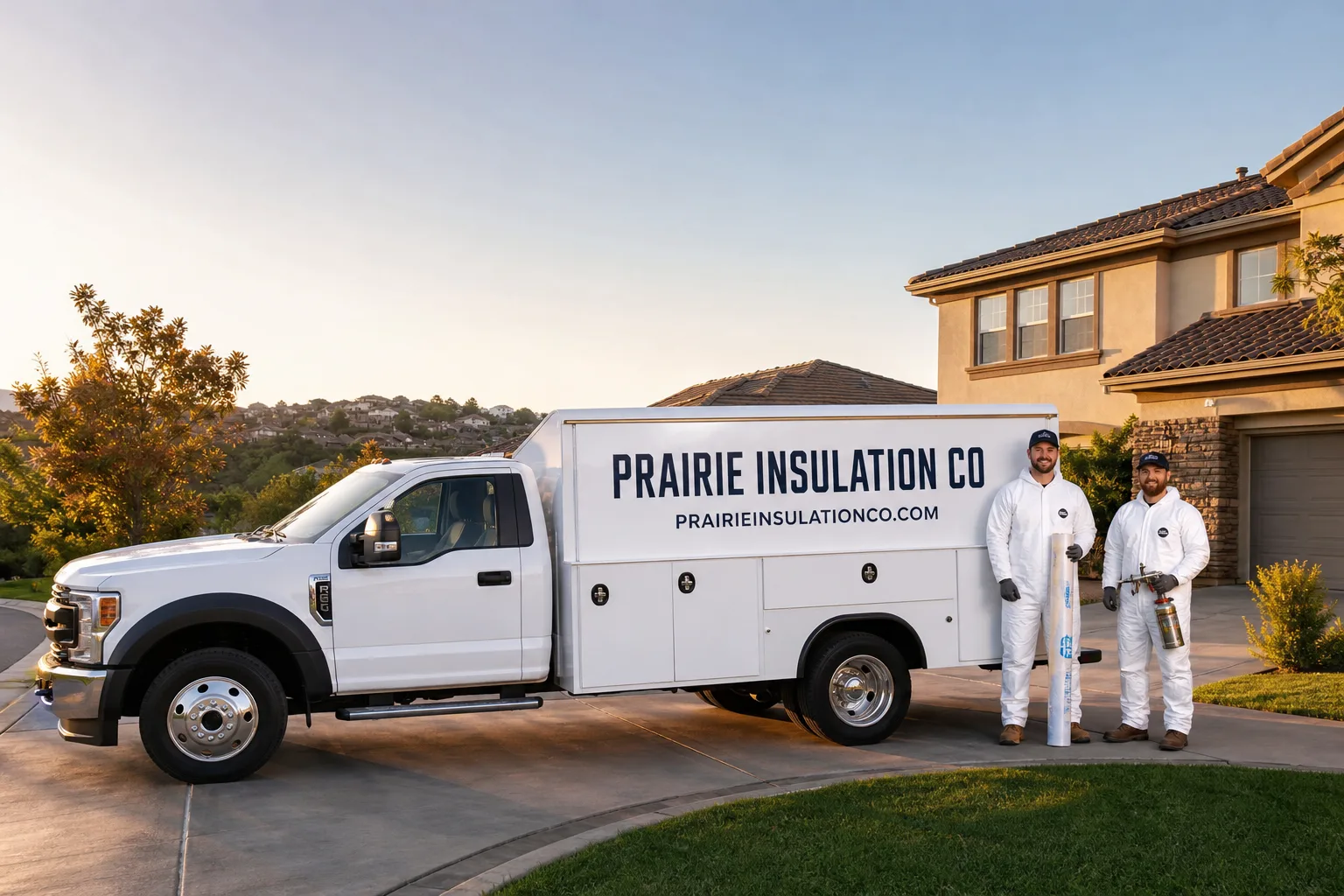
Fast, Reliable Spray Foam Insulation Across Lake Forest
Spray foam insulation in Lake Forest typically costs $2,800 – $7,200 for a full attic retrofit, with most single-story ranch homes falling between $3,200 and $5,400 depending on square footage and whether we’re removing old batts first. We run crews into Lake Forest weekly, usually arriving within two to three business days of your call. What makes Lake Forest work different is the housing stock: 1960s through 1980s tract homes with low-pitch concrete-tile roofs and attics that were barely insulated to begin with. We know these homes. We know what’s under those tiles. Call (855) 219-0368 and we’ll tell you straight what your attic actually needs.
Why Prairie Insulation Co Is Lake Forest’s Preferred Spray Foam Insulation Company
Lake Forest homeowners call us because we don’t show up pushing a single product line. We carry eight insulation brands including Owens Corning, Johns Manville, and Rockwool, and we specify spray foam systems from Icynene and Demilec. That matters here because the right foam chemistry for a 1970s ranch off El Toro Road is not automatically the right one for a lake-adjacent townhome. We stock materials sized for Lake Forest’s typical attic bays and low-clearance spaces, which means fewer return trips and less of you missing work.
Ken Sobecki, who leads our team, has spent years working Orange County’s older tract housing. He’ll tell you the same thing in person he says on the phone: no single product does everything. Some Lake Forest attics want open-cell foam for air sealing; others need closed-cell against the roof deck to handle the Saddleback Valley’s inland heat. The point is we recommend what fits your house, not what’s easiest for us to install.
We’re not the cheapest insulation contractor serving Lake Forest, and we don’t try to be. We’re the crew that will belly-crawl your 1970s attic, pull out forty-year-old batts, and do the prep right before the foam gun ever comes out. That’s the reputation we’ve built in 92630.
Open Cell Spray Foam in Lake Forest
Open cell spray foam is the workhorse retrofit material for Lake Forest attics, and a full roof-deck application in a typical 1,400 – 1,800 square foot single-story home here runs $3,200 – $5,200. In a city where original insulation was often thin R-11 or R-13 fiberglass, open-cell foam gives us an air seal that older materials simply can’t deliver. It expands into gaps, locks out the Santa Ana winds that drive heat through knee walls, and brings attics up to modern Title 24-era performance without requiring a full roof tear-off.
Why Open-Cell Works in Older Lake Forest Attics
Open-cell foam is forgiving in the irregular, shallow attic spaces we see throughout the older Lake Forest tracts. It conforms around truss webs, plumbing vents, and electrical runs that would force us to cut and fit batts piece by piece. For the ranch homes near the lake where clearance is under 40 inches at the peak, that conformability is the difference between a complete air barrier and a patchwork job.
We see this constantly in the neighborhoods around El Toro Road and Trabuco Road: attics where the original insulation has settled to half its rated depth. Open-cell foam doesn’t settle. Once it cures, it holds its shape and its R-value for the life of the home. That matters in the inland summer heat that bakes through those low-pitch tile roofs from June through September.
When Open-Cell Is the Right Call
If your Lake Forest home has a vented attic and your main complaints are uneven room temperatures and upstairs rooms that won’t hold cool air, open-cell foam applied to the roof deck or attic floor is usually what we specify. It’s also the better choice for homeowners who want sound dampening along with thermal performance, a real benefit in the denser townhome clusters around the lake.
Spray Foam Insulation Contractors in Lake Forest
Spray foam insulation contractors in Lake Forest are not all the same, and if you’ve had quotes from two companies, you’ve probably seen the gap. A full spray foam attic retrofit in the 92630 area runs $3,500 – $7,200 depending on whether we’re working in a small single-story ranch or a two-story home with attached garage. The bigger variable is prep: many Lake Forest homes still have original vermiculite or compressed fiberglass in the attic, and proper removal and surface prep can add $800 – $1,500 to the job. Skipping that step is how you end up with trapped moisture and foam that doesn’t adhere.
What Makes a Lake Forest Retrofit Different
Lake Forest’s older homes present a specific challenge: concrete-tile roofs that hold heat while hiding whatever thin, settled insulation sits below them. We’ve opened attics off Lake Forest Drive where the tile looked fine from the street and the attic underneath was almost bare. A contractor who doesn’t know 1960s – 1980s tract construction might spray right over that. We won’t.
Prep, Air Sealing, and the Details That Count
Before we spray, we remove the old material, inspect the roof deck for gaps and penetrations, and air-seal the plane. In low-clearance spaces our techs work on their bellies because that’s what the job takes. Surface prep matters in Lake Forest’s cooler spring mornings, when an improperly mixed ratio can cause off-gassing and shrinkage later. We tune our rigs for ambient attic temperature, and we don’t rush the cure.
Trusted Brands We Service in Lake Forest
For Lake Forest spray foam work, we specify Icynene and Demilec systems because both have track records in retrofit applications like the ones we encounter across 92630. We install open-cell and closed-cell foam from these lines, and we keep the accessories and sealants matched to each system in stock so Lake Forest jobs don’t stall waiting on parts. We also carry Owens Corning, Johns Manville, and Rockwool for hybrid projects where part of the home wants spray foam and another section is better served by mineral wool or dense-packed fiberglass. The goal is the right insulation for this home, not brand loyalty for its own sake.
Common Spray Foam Insulation Problems We See in Lake Forest Homes
- Foam sprayed directly over settled batts or vermiculite. We’ve pulled more than a few old Lake Forest attics where a previous contractor sprayed over compressed fiberglass or loose vermiculite without removing it first. The foam can’t bond properly, moisture gets trapped, and performance drops well below spec.
- Gaps and voids behind knee walls. The two-story tract homes along the Saddleback Valley foothills often have knee-wall cavities that get skipped in a rush job. Santa Ana winds drive heat through those gaps, and homeowners feel it in the rooms directly below.
- Poor adhesion in low-clearance spaces. When installers can’t reach the full depth of a shallow attic, foam gets applied too thin to form a proper air barrier. We see this in the older single-story ranches around Foothill Ranch and Portola Hills, where attic peaks are under 40 inches.
- Off-gassing and shrinkage from bad mix ratios. Spring mornings in Lake Forest are cool enough that a rig not tuned for ambient temperature can produce an off-ratio mix. The foam cures with a persistent odor and can pull away from framing within a year or two.
Pricing for Spray Foam Insulation in Lake Forest, CA
Here are the numbers we quote most often for Lake Forest homes. Open-cell foam in a typical 1,400 – 1,800 square foot home runs $3,200 – $5,200 for the attic. Closed-cell foam, which is denser and carries a higher R-value per inch, runs $4,800 – $7,200 for the same footprint. Removing old insulation adds $800 – $1,500 depending on depth and accessibility. Garage ceiling spray foam in Lake Forest runs $900 – $1,800, and rim joist work runs $450 – $1,200 for most homes. The exact price depends on square footage, attic access, and how much prep your home needs, but those ranges hold true for the vast majority of our Lake Forest quotes. Call (855) 219-0368 for a free estimate with the actual numbers, not a vague range.
We Also Serve Cities Near Lake Forest
Beyond Lake Forest, we run crews into Foothill Ranch, Portola Hills, Mission Viejo, and Laguna Woods on a regular schedule. If you’re in any of those neighboring communities and need Spray Foam Insulation work, the same crew and the same eight-brand lineup serve the whole Saddleback Valley area. Learn more about our work in Lake Forest or call us for a neighboring ZIP.
Serving Lake Forest, CA — Our Local Coverage Area
We’re based in the Lake Forest area and know this community well. Use the map below to see our service coverage — if you’re nearby, we can almost certainly help.
FAQs About Spray Foam Insulation in Lake Forest
No. In a Lake Forest attic, spray foam must go onto a clean, dry surface, and that means removing original fiberglass batts first. Many 1960s – 1980s homes here still have their original R-11 or R-13 batts, and spraying foam over them traps the old material’s settled dust against the roof deck while preventing proper adhesion. We remove the old insulation, inspect what’s underneath, then spray. Call (855) 219-0368 and we’ll tell you exactly what’s in your attic before we quote the job.
Yes, and in fact low-clearance attics are where spray foam makes the most sense, because batts can’t be installed correctly in a space where no one can stand up. Our crews do this work on their bellies in Lake Forest attics every week. The job takes longer than a wide-open attic, and we plan for that in the estimate, but the finished air seal is complete and continuous.
It affects the attic conditions more than the installation itself. Concrete-tile roofs hold heat late into the evening, and that heat soaks down into the attic cavity. In Lake Forest’s inland Saddleback Valley summers, the roof deck can reach temperatures that make closed-cell or open-cell foam the right answer over fiberglass, which cannot block radiant heat the same way. We assess your specific roof and attic before recommending one system over the other.
Spray foam outperforms traditional fiberglass in Lake Forest’s summer conditions because it creates an air seal as well as an R-value layer. Fiberglass and even blown-in cellulose allow air movement, which in an attic means hot air from the roof deck circulating into your living space. Spray foam stops that convective loop. Homeowners here typically notice the difference in August, when the inland sun loads those low-pitch tile roofs for hours at a time.
We specify Icynene and Demilec spray foam systems for Lake Forest work, with open-cell as the default for most vented attics and closed-cell where moisture or space constraints call for it. Both are widely specified by energy auditors and building scientists for the kind of retrofit housing that dominates 92630. We also stock Owens Corning, Johns Manville, and Rockwool for hybrid applications where a portion of the home is better served by a different material.
Written by Ken Sobecki, owner of Prairie Insulation Co, serving Lake Forest and the Saddleback Valley.