
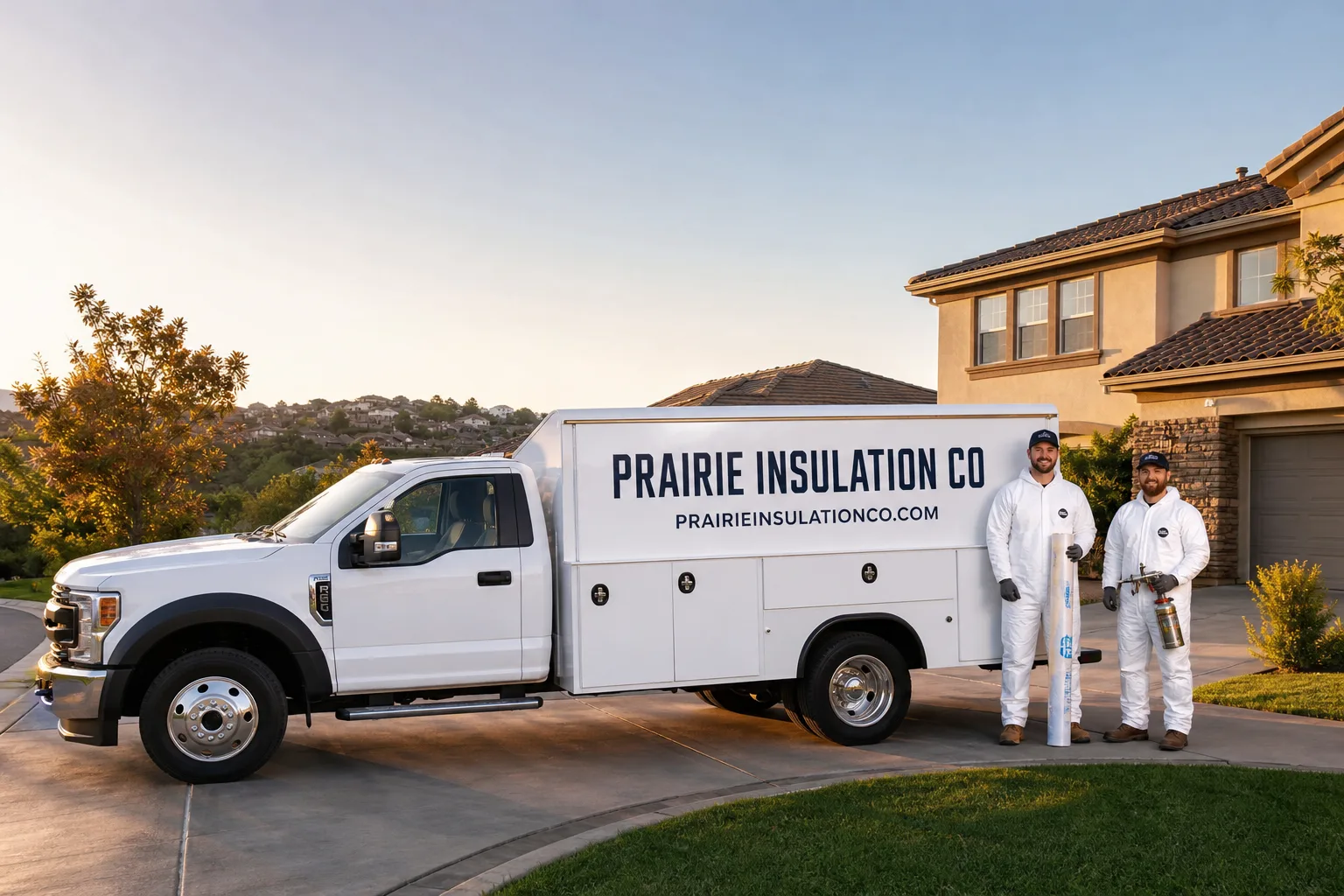
Spray Foam Insulation in Long Beach: What It Costs and Why Moisture Control Matters More Than R-Value
Spray foam insulation in Long Beach typically costs $2.50 to $6.80 per board foot installed, with most whole-wall projects landing between $3,200 and $8,900 depending on whether you choose open-cell or closed-cell and how much air sealing the job requires. In this coastal climate, the bigger question is not how much insulation you add but whether it’s installed with proper vapor management. Our crews work throughout Long Beach weekly, and we answer calls at (855) 219-0368 for free estimates.
Fast, Reliable Spray Foam Insulation Across Long Beach
We know Long Beach homes because we’re inside them every week, from the Craftsman bungalows off 4th Street in Retro Row to the stucco tract homes north of Willow Street. When you call Prairie Insulation Co, you reach an insulation contractor who understands what the marine layer does to wall cavities, what salt air does to rim joists, and why a 1920s single-wall bungalow in 90803 needs a completely different approach than a 1960s tract home in 90806. We respond to Long Beach calls within one business day for quotes, and emergency moisture assessments can often be scheduled same week. Call us at (855) 219-0368 and we’ll tell you honestly whether spray foam is the right material for your home, or whether a different insulation strategy makes more sense.
Why Prairie Insulation Co Is Long Beach’s Preferred Spray Foam Insulation Company
Long Beach homeowners deal with a problem most insulation contractors never address: moisture. The coastal fog belt keeps interior walls damp for months at a time, and adding insulation without air sealing is how mold starts behind foam. Our crews see this consistently in Alamitos Beach and Belmont Shore, where ocean-driven humidity meets uninsulated stucco and condenses on cold mornings. We do not just spray foam and leave. We assess where the water is coming from first.
Our work in Long Beach spans both Spray Foam Insulation systems we install: Icynene open-cell for interior walls and sound damping, Demilec closed-cell for rim joists, crawl spaces, and anywhere water vapor is the enemy. Because we carry both chemistries plus Rockwool, Knauf, and Johns Manville products, we recommend the material that fits your specific house, not the one we happen to stock. Ken Sobecki, our owner, has built the company around that material-agnostic approach, and Long Beach’s older housing stock is exactly where it pays off.
Spray Foam Wall Insulation in Long Beach
Spray Foam Wall Insulation in Long Beach is rarely just about adding R-value. In the pre-war bungalows of 90802 and 90803, original uninsulated walls mean every retrofit must first address vapor barriers and air sealing, or the foam will trap moisture from the marine layer inside the wall cavity and lead to condensation and mold. A typical spray foam wall project in Long Beach runs $3,500 to $8,900 for a single-story home, with closed-cell costing more than open-cell but providing that critical vapor resistance.
Interior Wall Cavities in Older Homes
When we open a wall in a Craftsman or Spanish Revival home near Bixby Knolls or Rose Park, it’s often empty or holding degraded 1920s newspaper insulation. Open-cell foam, typically Icynene, works well here because it fills odd cavities completely and lets the wall dry to the interior. We pair it with proper vapor barriers on the exterior, which is where the real moisture control happens.
When to Choose Closed-Cell in Coastal Zones
Closed-cell foam, including Demilec systems, performs best on the west-facing walls of Belmont Shore and Peninsula homes that catch ocean wind and fog. At roughly $4.00 to $6.80 per board foot installed, it’s more expensive, but it acts as its own vapor barrier and adds structural rigidity to older framing. For Long Beach homes within a quarter mile of the water, we recommend closed-cell on exterior walls.
Rim Joist Spray Foam in Long Beach
Rim joist spray foam in Long Beach serves one main purpose: sealing the gap where your foundation meets your framing, which is where humid ocean air leaks into crawl spaces and basements year round. In the 1920s to 1940s homes of 90804 and 90805, rim joists are often wide open to whatever the marine layer throws at them, and closed-cell spray foam is the only material that both insulates and blocks the moisture. Expect to pay $1,800 to $4,200 for a typical Long Beach crawl space or basement rim joist project.
Why Rim Joists Fail First Near the Coast
Salt air accelerates corrosion on the metal fasteners and hardware in and around rim joists. Galvanized nails, joist hangers, and sill plates in Long Beach garages and crawl spaces rust faster than inland, which means spray foam at the rim can fail prematurely if the metal underneath isn’t stainless or at minimum coated. Our crews inspect fasteners before we foam and recommend corrosion-resistant replacements where needed, because foam hides what’s happening underneath.
Garage and Crawl Space Applications
We recently sprayed rim joists in a 1920s bungalow near Alamitos Beach where the homeowner had already added fiberglass batts but still felt dampness. Our crew removed the old insulation, air-sealed the rim with closed-cell spray foam, and installed a vapor barrier, eliminating the condensation that had been forming on the cold stucco walls. That’s the difference between adding insulation and solving a moisture problem.
Trusted Brands We Service in Long Beach
We install and service spray foam and insulation materials from eight leading manufacturers, including Johns Manville, Knauf, and Rockwool for applications where foam is not the best answer. Because we stock these lines and work with them daily, we can recommend the right one for a 1930s Craftsman with knob-and-tube wiring versus a 1960s tract home with standard framing. Long Beach customers get fast turnaround because we do not have to order every specialty product. We carry what your house needs or we tell you honestly what product will work better. No single product does everything, and in Long Beach’s fog belt, that truth matters more than anywhere we work.
Common Spray Foam Insulation Problems We See in Long Beach Homes
- Trapped moisture behind foam in pre-war bungalows. Homes built before 1945 in 90802 and 90803 often have no exterior vapor barrier, so ocean air moves through stucco and condenses behind closed-cell foam. Without air sealing first, mold develops out of sight.
- Inadequate attic ventilation causing condensation on foam. Older Long Beach attics with minimal soffit or ridge vents trap humid marine air, and the underside of spray foam becomes a condensing surface. We recommend upgrading ventilation before foaming roof decks in homes from the 1920s through the 1960s.
- Salt-air corrosion on garage hardware around rim joists. Springs, hinges, and fasteners in detached and attached garages throughout Long Beach corrode years faster than inland. Foam installed over rusting metal hides future failure, so we inspect and replace corroded components with stainless or coated hardware before spraying.
- Knob-and-tube wiring complications in older neighborhoods. In Retro Row, Rose Park, and parts of Belmont Heights, original knob-and-tube wiring makes wall cavities unsafe for spray foam until the wiring is assessed. We coordinate with electricians to ensure the spray foam does not encapsulate live wiring, which is a code issue and a fire risk.
Pricing for Spray Foam Insulation in Long Beach, CA
Open-cell spray foam in Long Beach runs $2.50 to $4.00 per board foot installed. Closed-cell runs $4.00 to $6.80 per board foot. A 1920s bungalow wall retrofit in 90802 or 90803 typically costs $3,500 to $7,200. Rim joist sealing in a crawl space or garage runs $1,800 to $4,200. Roof deck spray foam, often needed when we’re also addressing attic condensation, adds $5,000 to $11,000 depending on square footage. What changes your price: wall accessibility, the amount of air sealing needed, whether old insulation must be removed, and whether your home has knob-and-tube wiring to work around. We give written, upfront quotes before any work starts, and estimates are free. Call (855) 219-0368 and we’ll measure your house and give you the actual number.
We Also Serve Cities Near Long Beach
Prairie Insulation Co serves all of Long Beach and the surrounding communities. If you live in Signal Hill, Lakewood, Los Alamitos, or Rossmoor, we cover those areas with the same crews and the same eight-brand material access we bring to Spray Foam Insulation in Long Beach. The coastal moisture conditions we handle in Long Beach extend into these nearby cities, especially Rossmoor and Los Alamitos, so the approach carries over.
Serving Long Beach, CA — Our Local Coverage Area
We’re based in the Long Beach area and know this community well. Use the map below to see our service coverage — if you’re nearby, we can almost certainly help.
FAQs About Spray Foam Insulation in Long Beach
In most Long Beach homes, yes, a vapor barrier or closed-cell foam with a built-in vapor retarder is required on exterior walls and rim joists to prevent marine moisture from condensing behind the insulation. Open-cell foam alone will not stop water vapor from the fog belt, so we pair it with a separate vapor barrier on the warm side of the wall. Closed-cell foam acts as its own vapor barrier and can eliminate the need for a separate layer in many cases. Call (855) 219-0368 and we’ll tell you which approach fits your home.
Salt air does not degrade cured spray foam itself, but it accelerates corrosion on the metal fasteners, hinges, tracks, and opener chains near where foam gets installed. That’s why we inspect and often replace galvanized hardware with stainless or coated versions before spraying rim joists or garage ceilings. If you skip that step in a Long Beach garage, the foam hides rust that keeps eating away underneath. We have been dealing with this pattern for years and address it on every garage job.
Spray foam does not cause mold, but improperly installed spray foam in Long Beach’s fog belt can trap moisture and create conditions where mold grows on surrounding materials. This happens most often when foam is sprayed over existing moisture-laden walls or when attic ventilation is inadequate and humid air condenses on the foam. In Alamitos Beach and Belmont Shore, where ocean humidity is constant, we always check wall moisture levels and ventilation before spraying. If we find active moisture, we address that first.
Closed-cell spray foam is the best material for rim joists in Long Beach’s older homes because it insulates, blocks water vapor, and adds rigidity to the vulnerable foundation-to-framing connection. In homes built between 1920 and 1960 in ZIPs like 90804 and 90805, rim joists are often exposed to crawl space air, and closed-cell foam (typically Demilec or Icynene closed-cell) solves both the insulation and moisture problem in one application. It costs more than open-cell, but rim joists are a small area, so the total price difference is usually modest. Call (855) 219-0368 for an exact quote on your crawl space.
In many older Long Beach homes, yes, you need to upgrade attic ventilation before spraying foam on the roof deck, because inadequate ventilation traps humid marine air and causes the foam to become a condensing surface. Homes from the 1920s through the 1960s in Long Beach often have minimal soffit vents and no ridge vent, which works fine with no insulation but fails once you change the thermal profile. We assess attic airflow as part of every roof deck spray foam estimate in Long Beach. If ventilation needs work, we’ll tell you before we quote the foam job.
Get a Free Estimate for Spray Foam Insulation in Long Beach
Whether you’re in a Craftsman bungalow in Rose Park, a stucco tract home in 90806, or a beach-adjacent condo in Belmont Shore, we’ll help you sort out what your walls actually need. We’re licensed, insured, and bonded, and we carry the materials to match the right insulation to your home’s specific conditions. Call Prairie Insulation Co at (855) 219-0368 for a free, no-pressure estimate. We’ll measure, inspect, and give you an honest recommendation, even if that means telling you spray foam is not the right answer for your Long Beach home.
Written by Ken Sobecki, Owner at Prairie Insulation Co, serving Long Beach and surrounding coastal communities.