
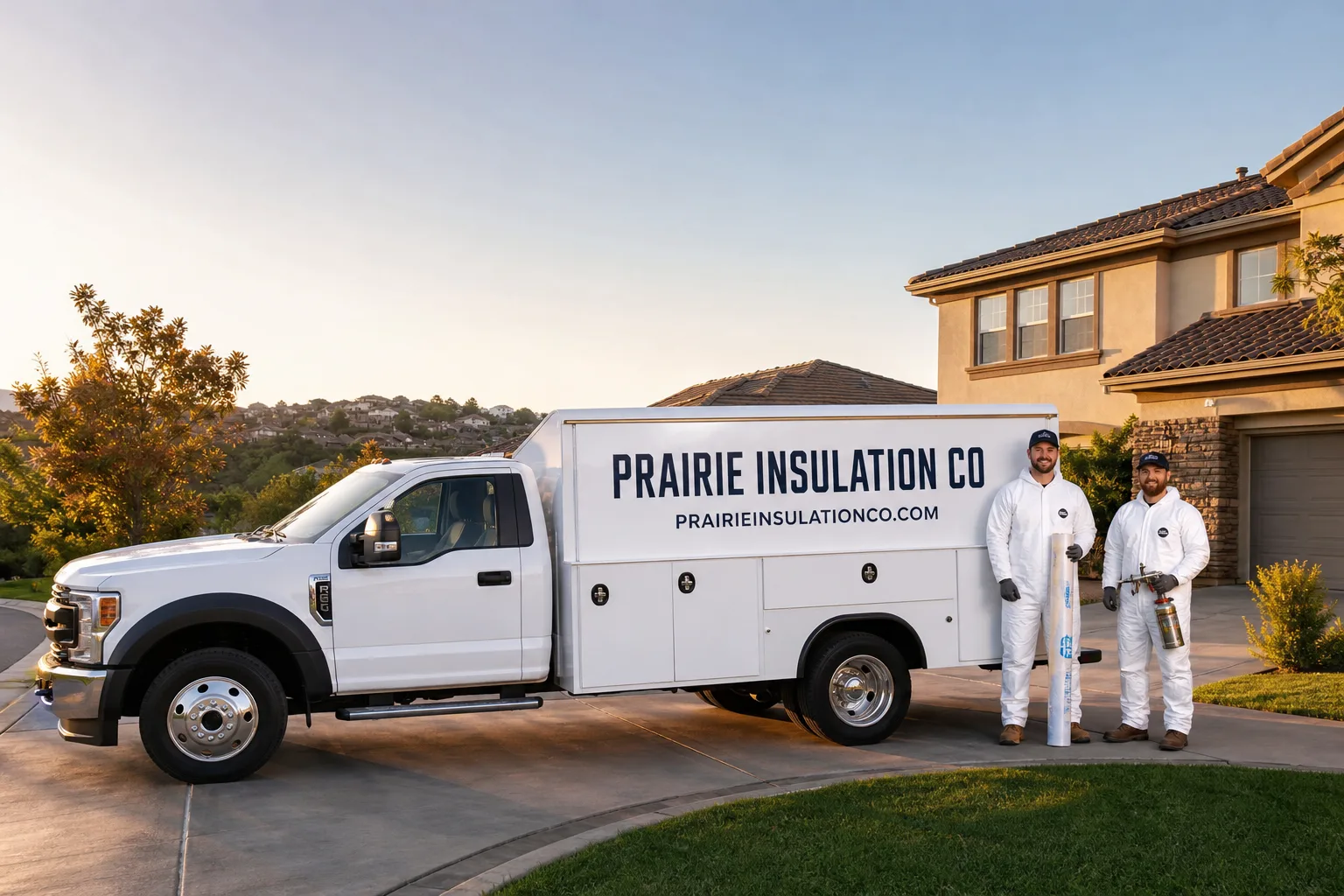
Fast, Reliable Spray Foam Insulation Across Eastvale
Spray foam insulation in Eastvale usually costs between $2,800 and $6,400 for a typical attic air-sealing and rim-joist package, with open-cell running lower and closed-cell higher. Most homes here need it for a specific reason: builder-grade shortcuts from the late 1990s and 2000s construction boom, not failing old insulation. Eastvale’s tract homes were put up fast, and the gaps left behind are what we find every week. If your second-floor hallway bakes on hot days or your AC runs constantly from June through September, call Prairie Insulation Co at (855) 219-0368. We know Eastvale’s housing stock because we’re in these attics and crawl spaces all year.
Why Prairie Insulation Co Is Eastvale’s Preferred Spray Foam Insulation Company
We carry eight insulation brands, and that shapes how we approach every Eastvale home. Owens Corning, Johns Manville, Knauf, Rockwool, CertainTeed, Icynene, Demilec, and GreenFiber are all on our trucks, so we specify the right chemistry for the job instead of pushing one product line. For Eastvale’s stucco tract homes, that usually means Icynene open-cell for attic air-sealing and Demilec closed-cell for rim joists and garage ceilings. We’re not tied to one manufacturer’s spec sheet, and that matters when we’re diagnosing builder-grade gaps rather than replacing degraded legacy material.
Ken Sobecki leads our crews, and his approach to spray foam is straightforward: identify where conditioned air is leaving, then seal it with the material that fits the cavity and the budget. Eastvale homeowners call us after spending a summer with rooms that won’t hold temperature. We start with the attic hatch, the rim joist, and the wall top plates, because those are where tract builders cut corners. Call (855) 219-0368 and we’ll walk you through what we typically find in your neighborhood before we ever schedule a job.
Crawl Space Spray Foam Insulation in Eastvale
Crawl Space Spray Foam Insulation in Eastvale addresses a problem most homeowners in this city don’t know they have: hot, dusty air moving through the vented crawl space and into first-floor rooms through unsealed floor penetrations. Because Eastvale sits in the Inland Empire’s inland valley, the crawl space under a stucco tract home heats up fast during those 100°F+ stretches, and that heat finds its way through plumbing chases and subfloor gaps. We typically recommend closing and conditioning the crawl space with closed-cell spray foam on the perimeter walls, then sealing the ground with a vapor barrier. It changes the first-floor comfort immediately.
When the Crawl Space Is the Source
You’ll know because the floors over the crawl space feel warm in summer even when the AC is running, and dust from Santa Ana wind events shows up inside cabinets and along baseboards. Those fine particles come up through the subfloor. Foaming the rim joist and the crawl space perimeter stops that path. In Eastvale, most crawl space foam jobs on a standard two-story tract home run $3,400 to $6,800 depending on access height and whether we’re also air-sealing the subfloor penetrations.
Closed-Cell for Moisture Control
We use Demilec closed-cell foam here because the Inland Empire’s dry heat isn’t the only condition at play. Winter irrigation and occasional heavy rains can raise crawl space humidity, and closed-cell acts as a moisture barrier as well as an air seal. It’s the right material for this application, not the cheapest one, and we’ll explain why before we bid.
Garage Spray Foam Insulation in Eastvale
Garage Spray Foam Insulation in Eastvale is about taming the hottest room that most homeowners ignore. In the neighborhoods off Schleisman and Harrison, attached garages with uninsulated ceilings and shared walls act like heat batteries, bleeding hot air into adjacent living space every afternoon. A standard two-car garage ceiling foamed with open-cell Icynene typically runs $1,900 to $3,400 in Eastvale. If the garage shares a wall with a bedroom or the stairwell, sealing and foaming that shared wall is one of the best comfort upgrades per dollar we can recommend.
Shared Walls and Second-Floor Hallways
On a two-story tract home off Schleisman, our crew found the builder-grade attic hatch completely uninsulated and unsealed, so 105°F attic air was dumping straight into the second-floor hallway. We sealed the hatch and stairwell framing and foamed the rim and penetrations with Icynene, and the upstairs hallway stopped baking by mid-afternoon. That’s not an isolated case in Eastvale. It’s the pattern.
Garage Ceiling as a Thermal Lid
Most Eastvale garages have bare ceiling joists open to the attic above. Foaming the garage ceiling seals that thermal boundary, and for homes where the garage sits under a bedroom, the change is immediate. We also foam the garage rim joist during the same visit, which catches the air leaking through the mudsill that most insulation retrofits never address.
Trusted Brands We Service in Eastvale
Our Eastvale crews work with both Icynene and Demilec spray foam systems, plus Rockwool for homes that need fire resistance or sound control that standard fiberglass can’t deliver. We stock the materials for Eastvale’s typical project profile at our Ladera Ranch yard, so turnaround on your street isn’t held up by a distribution delay. If your home needs a hybrid approach, say closed-cell at the rim and Rockwool in the wall cavities, we’re equipped to do that in one visit with one crew. No subcontracted insulation crews. No waiting on a second contractor to show up.
Common Spray Foam Insulation Problems We See in Eastvale Homes
- Uninsulated builder-grade attic hatches. Nearly every production-built Eastvale home has an attic access panel with zero insulation and no gasket. On a 105°F day, the attic space above it can hit 140°F, and that heat pours into the hallway below. Foaming and sealing the hatch is a small job with outsized impact.
- Missing or compressed R-13 exterior wall batts. Because Eastvale’s stucco walls hide everything, homeowners never see the bays where the builder skipped or compressed the batt. We find these gaps from the attic side and foam the accessible cavities, which restores wall performance without tearing off stucco.
- Over-trusted radiant barrier foil. Many Eastvale attics have radiant barrier on the roof deck, and owners assume it’s the reason their attic stays tolerable. The foil reflects some heat, but it does nothing for the unsealed penetrations and compressed blown-in insulation below it. We see this assumption in nearly every tract subdivision.
- Dust-loaded batt insulation from Santa Ana winds. Eastvale’s dry, windy Santa Ana events push fine dust through soffit vents into attic spaces. Over five to ten years, that dust settles into fiberglass batts and degrades their effective R-value. Foam doesn’t collect dust the same way, which is one reason we specify it for attic air-sealing here.
Pricing for Spray Foam Insulation in Eastvale, CA
You’ll spend more for closed-cell than open-cell, and the square footage of the area being treated drives the final number. Open-cell attic air-sealing in Eastvale typically runs $2,800 to $4,900 for a 2,000 to 2,800 square foot two-story tract home. Closed-cell rim joist work on the same house adds $1,400 to $2,600. A full crawl space encapsulation with closed-cell runs $3,400 to $6,800, and a garage ceiling foamed with open-cell lands between $1,900 and $3,400. We give fixed written quotes, so the number you approve is the number you pay. Call (855) 219-0368 for a free estimate at your Eastvale home, and we’ll walk the attic and crawl space with you before we quote anything.
We Also Serve Cities Near Eastvale
Our crews cover Eastvale and the surrounding Inland Empire communities, including Norco, Home Gardens, Corona, and Jurupa Valley. If you’re in one of those cities and dealing with builder-grade insulation shortcuts, the same Spray Foam Insulation diagnosis applies. We schedule by neighborhood cluster, so call and we’ll tell you when we’re next in your area.
Serving Eastvale, CA — Our Local Coverage Area
We’re based in the Eastvale area and know this community well. Use the map below to see our service coverage — if you’re nearby, we can almost certainly help.
FAQs About Spray Foam Insulation in Eastvale
Yes, in most Eastvale homes radiant barrier addresses only radiant heat gain, not air leakage. The foil reflects some of the sun’s heat from the roof deck, but it doesn’t seal the attic hatch, wall top plates, plumbing penetrations, or recessed light cans where conditioned air escapes. On a two-story tract home near Harrison, we found intact radiant barrier foil while exterior-wall batts were missing in two bays, meaning the homeowners had been trusting the foil to do work it was never designed to do. Foam seals the actual thermal boundary. Call (855) 219-0368 if you want us to check your attic’s air-sealing.
Yes, we can foam the accessible portions of exterior wall cavities from the attic side without removing stucco or drywall. Eastvale’s wood-frame stucco construction leaves the top plates and upper wall bays reachable from the attic, and that’s where most of the heat loss or gain happens. For lower wall sections behind stucco, we assess whether the existing R-13 batts are present and intact before recommending any invasive work. Most of the time, the attic-side sealing gets you most of the comfort improvement at a fraction of the cost.
In Eastvale tract homes, the second-floor hallway is usually hot because the attic hatch above it is uninsulated and unsealed, and the wall top plates along that hallway are leaking attic air into the conditioned space. We find this pattern in homes throughout the 92860 zip code, from the older west-side tracts to the newer east-side subdivisions. The fix is foaming and sealing the hatch, the stairwell framing, and the rim joist, which typically brings the hallway temperature down within a day or two. Call (855) 219-0368 and we’ll diagnose yours.
Yes, and it happens slowly enough that homeowners rarely notice. When Santa Ana events push dust through Eastvale’s soffit vents, that dust settles into fiberglass batt insulation and reduces its ability to resist heat flow. After five to ten years, the R-13 batts that were marginal from the start are doing even less. Foam insulation is less prone to this because it air-seals the cavity it fills, which keeps dust from moving through. If your home has seen a decade of wind events, your attic insulation is doing less than you think.
You typically can’t tell from inside the house, and that’s the problem. Eastvale’s production builders were working fast, and insulation inspection was not always thorough. We find missing or compressed batts from the attic side during a visual inspection, looking down into the wall cavities where the top plates are exposed. If you’re experiencing rooms that won’t hold temperature even after upgrading the attic, missing wall batts are a likely culprit. A free inspection from Prairie Insulation Co will tell you exactly what’s in your walls. Call (855) 219-0368.
Written by Ken Sobecki, Owner at Prairie Insulation Co, serving Eastvale and the Inland Empire with material-agnostic insulation work across eight manufacturer brands.