
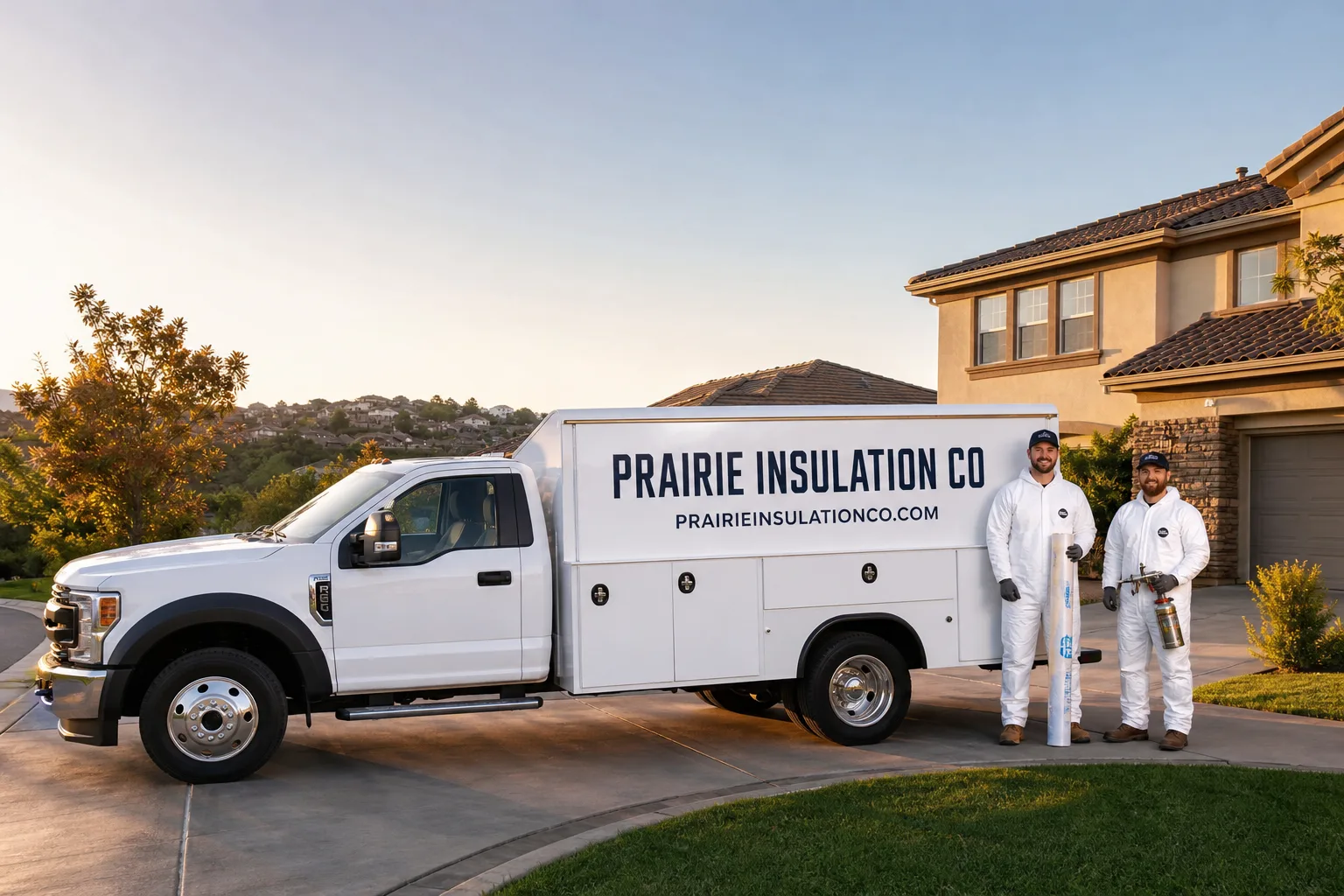
Fast, Reliable Attic Insulation Across Tustin
Attic insulation in Tustin is rarely a one-size-fits-all job. The city’s housing stock runs from 1950s ranch homes in 92780 with attics that haven’t been touched since Eisenhower was president, to 1990s two-story stucco builds in Tustin Ranch that were insulated to code minimums and never improved. That split matters. What fixes a drafty original ranch on Main Street won’t help a 92782 townhome losing conditioned air through can-light gaps. If your upstairs rooms won’t hold temperature or your attic turns into an oven by 2 p.m. from May through October, call us at (855) 219-0368. We’re the crew that matches the fix to the era of construction, not to whichever product is easiest to source.
Most Tustin homes in the 92780 and 92781 zip codes were built before attic ventilation was properly understood. Most in 92782 were built when insulation was treated as a box to check, not a system to design. We address both. Our trucks roll into Tustin from Ladera Ranch in about 30 minutes, and we stock the baffles, batts, and loose fill that Tustin’s older homes actually need.
Why Prairie Insulation Co Is Tustin’s Preferred Attic Insulation Company
Tustin homeowners call us because we don’t show up pushing one brand. We stock and install products from eight manufacturers, including Owens Corning, Johns Manville, Knauf, and GreenFiber, and we specify the material that fits the house. A 1962 ranch with 2×4 rafters and zero baffles gets a different treatment than a 1998 Tustin Ranch stucco with recessed lighting gaps. That’s how Ken Sobecki has run Prairie from the start: figure out what the attic actually needs, then match the product.
Response time to Tustin from our Ladera Ranch shop runs about 30 minutes in normal traffic, faster down the 5 or the 261 if the timing is right. We service every Tustin neighborhood, from the older tree-lined streets west of Red Hill to Columbus Square and Tustin Ranch east of the 55. Homeowners keep us busy here because they’ve learned what we learned years ago: a 60-year-old attic in central Tustin and a 25-year-old attic in 92782 are completely different jobs.
Attic Ventilation in Tustin
Attic ventilation in Tustin is the difference between an attic that works and an attic that fights you. In the 1950s and 60s ranch tracts of 92780, the biggest problem we find is baffle-related: original 2×4 rafters were built without them, so any blown-in insulation added later packs right up against the roof deck at the eaves. The soffit vents get choked. Air stops moving. The attic bakes. We treat baffle installation as a mandatory first step on these older Tustin homes, not an optional add-on. Expect to pay $8 – $15 per baffle installed, or roughly $400 – $900 for a typical ranch perimeter, depending on rafter bay count and access.
When Older Tustin Homes Need Full Ventilation Upgrades
A homeowner off Newport Avenue called us after noticing the upstairs hallway smelled faintly musty every morning. That’s the marine layer. When the 92780 morning cloud rolls in and a poorly vented attic can’t dry out, condensation forms on cool rafters and sheathing. Left alone, it becomes mold before the insulation itself ever fails. We see this pattern in original ranches with no baffles and no ridge or gable-movement correction.
Bringing 1980s and 90s Tustin Ranch Roofs Into Balance
The stucco two-story homes in 92782 and Tustin Ranch usually have ventilation, but it’s often out of balance. Turbines on one side, passive box vents on the other, and nobody ever checked whether intake at the eaves equals exhaust up top. That imbalance pulls conditioned air out of the living space and pulls 130-degree attic air into the duct runs. We correct it with calibrated intake and exhaust math, not guesswork.
Radiant Barrier in Tustin
A radiant barrier in Tustin’s inland heat makes real sense in the right attic. It’s a reflective foil layer, typically stapled to the underside of the rafters, that rejects a large share of the sun’s radiant heat before it ever warms the attic air. In Tustin’s 90-to-100-degree summer stretches, that’s the difference between an attic at 140°F and one at 115°F. The cooling load on your upstairs rooms drops noticeably when the barrier is installed correctly and the attic still has proper ventilation. A radiant barrier for a typical single-story Tustin ranch runs $1,200 – $2,400. A two-story Tustin Ranch home runs $2,200 – $4,000, with the added cost coming from additional roof geometry and access.
Stapled Foil vs. Spray-Applied: What Fits Tustin Homes
For most Tustin attics, we recommend stapled foil because it’s clean, lasts decades, and doesn’t trap moisture the way some spray-applied products can. But we don’t default to it. A tight attic with low clearance near the eaves is sometimes better served by a spray-applied radiant barrier, which we also install. The decision comes down to roof pitch, duct layout, and how much of the attic you actually use for storage.
Does a Radiant Barrier Replace Insulation? No.
We get this question constantly in Tustin Ranch. A radiant barrier only addresses radiant heat. It does not slow conductive heat transfer through the ceiling, and it does nothing for the duct losses that are the real drain on 92782 homes. You need both: the barrier up top, the insulation below. Priced together, a typical Tustin attic with both a radiant barrier and a proper blown-in insulation top-up runs $2,800 – $5,500 depending on square footage and whether we’re correcting ventilation at the same time.
Trusted Brands We Service in Tustin
We’re not tied to one manufacturer. That’s the point. Tustin ranch homes with original framing do well with GreenFiber loose fill, which settles into irregular 2×4 rafter cavities better than batts. Homes in 92782 with standard truss spacing often get Knauf or Johns Manville batts when the attic is accessible and the cavities are uniform. When a Tustin homeowner asks for strong fire performance and sound deadening between floors, we specify Rockwool. No single product does everything. That’s why we carry eight brands instead of one. When you call us at (855) 219-0368, you’re talking to a company that can actually recommend the right material, not the one we happen to stock.
Common Attic Insulation Problems We See in Tustin Homes
- Eave vents choked by old blown-in insulation in 92780 ranches. Original 2×4 rafters built without baffles mean any prior insulatio upgrade settled into the eave, blocking airflow. The attic never moves air, and the duct static pressure climbs until the upstairs won’t cool. We pull the old fill back, install baffles along the whole perimeter, and only then blow in new material.
- Code-minimum batts with gaps at the top plate in Tustin Ranch builds. 1980s and 90s stucco homes in 92782 were insulated to whatever the code required at the time, and the installs were rushed. Gaps at the top plate and around recessed cans let 130-degree attic air bypass right into the living space. We air-seal first, then bring the R-value up to at least R-49.
- Marine layer condensation on rafters and sheathing. Tustin sits far enough inland to bake all afternoon but close enough to the coast to catch morning cloud. When a poorly vented attic meets that moisture, the underside of the roof deck sweats. Mold follows. We see it on houses all over 92780 and in parts of 92781 where the eave ventilation was never adequate.
- Old loose fill that’s compressed, dirty, and doing almost nothing. A lot of Tustin ranches got cellulose or fiberglass blown in thirty years ago, and it’s now dust. Compressed from age and roof traffic, R-values drop hard. We remove it, inspect the framing, and re-insulate from scratch. It’s more work than a top-up, but it’s the difference between guessing and knowing.
Pricing for Attic Insulation in Tustin, CA
A typical attic insulation top-up in Tustin runs $1,800 – $3,200 for a single-story ranch of about 1,400 to 1,800 square feet. That includes bringing the attic up to R-49 with blown-in fiberglass or cellulose and air-sealing the worst bypas points. Full removal and replacement, common in 1950s – 60s Tustin homes with dirty or compressed loose fill, runs $3,500 – $6,500. Attic batt installation for an unfinished attic conversion or a Tustin Ranch two-story runs $2,200 – $4,800, including air-sealing at the top plates. Radiant barrier runs $1,200 – $2,400 for a ranch and $2,200 – $4,000 for a two-story. If you need baffles installed because your ranch never had them, that’s $400 – $900 on top of the insulation work. Every estimate is free. Call (855) 219-0368 and we’ll send Ken or one of his senior techs to walk your attic, take measurements, and give you a written number that won’t shift between the estimate and the invoice.
We Also Serve Cities Near Tustin
If you’re in Tustin, you’re our neighbor. We also run regular routes through North Tustin, Santa Ana, Irvine, and Orange, same response time, same crew. Many of our Tustin customers originally found us by word of mouth from friends in those nearby cities. For any attic insulation work in the area, Attic Insulation from Prairie Insulation Co is one call away.
Serving Tustin, CA — Our Local Coverage Area
We’re based in the Tustin area and know this community well. Use the map below to see our service coverage — if you’re nearby, we can almost certainly help.
FAQs About Attic Insulation in Tustin
Probably yes. 1980s and 90s Tustin Ranch homes in the 92782 corridor were insulated to code minimums that fall well short of what today’s climate demands. Expect R-19 or R-30 batts with gaps at the top plate and around can lights, which means your attic lets conditioned air out and hot attic air in. Upgrading to R-49 and air-sealing those gaps typically pays for itself through quieter, more stable room temperatures and lower summer cooling costs. Call (855) 219-0368 and Ken will inspect your attic and tell you honestly whether it’s worth upgrading or you’re fine for another five years.
Because older Tustin ranches in 92780 and 92781 were framed with 2×4 rafters and no baffles, which means any blown-in insulation added later blocks the eave vents and chokes off attic airflow. We consider baffle installation a mandatory first step on these homes. If we blow in new insulation without baffles, we’re just repeating the original mistake.
In Tustin’s summer heat, a radiant barrier adds real value on top of insulation, but it never replaces it. A radiant barrier rejects radiant heat from the sun; blown-in or batt insulation slows conductive heat transfer through your ceiling. A 92782 two-story with a hot upstairs benefits most from both, especially if the roof faces west or south. We’ll give you a straight recommendation after we see the attic, not before. Call (855) 219-0368 for a free attic assessment.
They’re barely the same job. A 1950s ranch typically still has original framing, old or nonexistent attic insulation, no baffles, and eave vents that are blocked. The work is about correction: installing baffles, air-sealing, removing or topping up old fill, and getting the attic to vent. A Tustin Ranch townhome has a truss-framed attic with code-minimum batts and specific gap problems at the top plate and around recessed lights. There, the job is tightening and upgrading. Our crew handles both; Ken matches the approach to your house, not to a template.
Morning marine layer in Tustin pushes moist air into attics that can’t dry out if they’re not properly vented. When the sun comes out and the attic heats up, that trapped moisture condenses on rafters and sheathing, eventually growing mold. That’s why we always air-seal before insulating and check ventilation as part of every Tustin attic job. Skipping those steps means the new insulation gets blamed for a problem that was always there. Call (855) 219-0368 for an inspection and a written plan.
Written by Ken Sobecki, Owner at Prairie Insulation Co, serving Tustin from our Ladera Ranch shop. Ken has spent years diagnosing and correcting attic insulation failures in Orange County’s older housing stock, and he still walks every Tustin attic himself before a single batt goes in.