
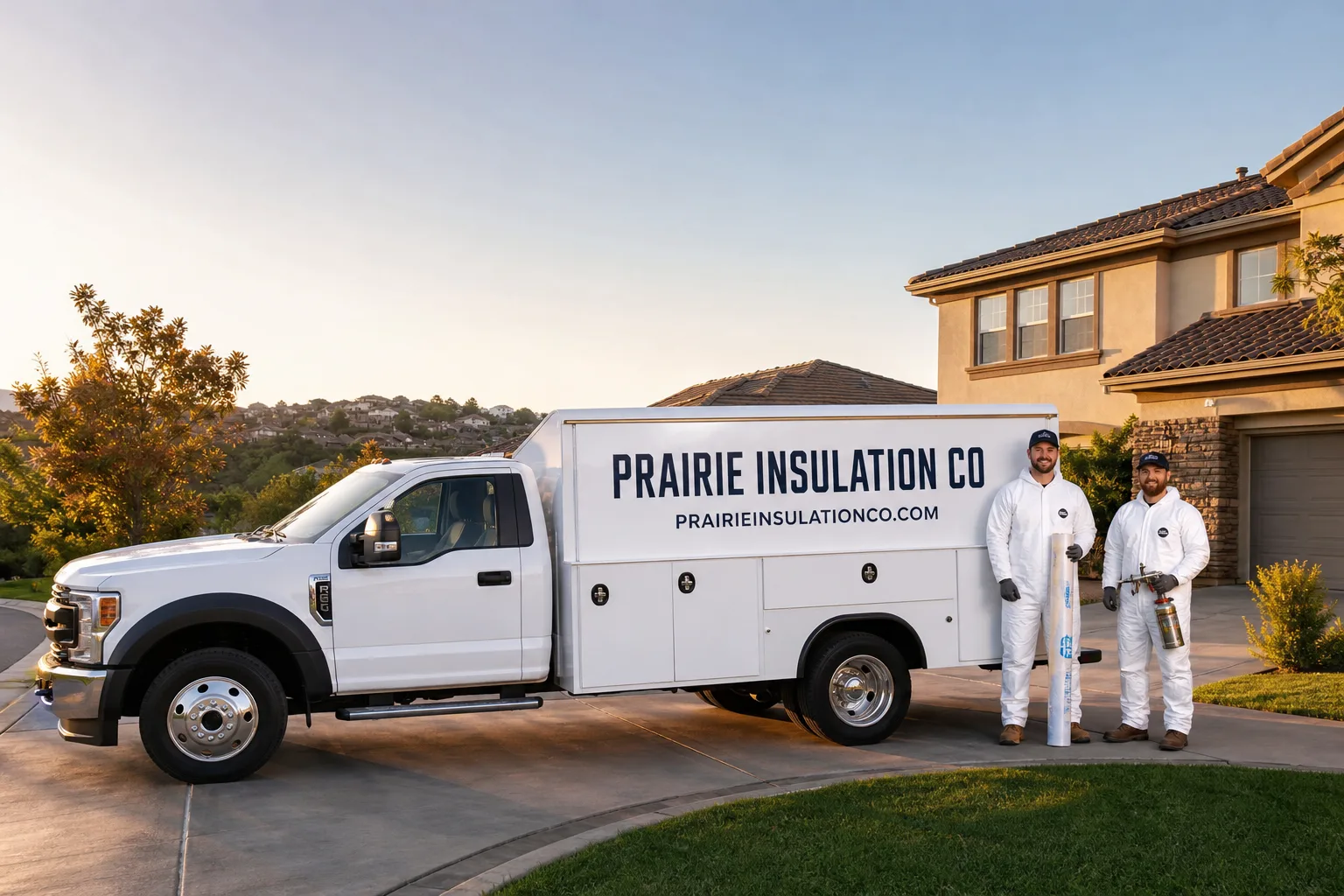
Fast, Reliable Attic Insulation Across Canyon Lake
Attic insulation in Canyon Lake usually means removing what’s already up there, not starting fresh. Most homes here were built between the late 1960s and the 1990s, and the original fiberglass has settled, compressed, or baked out under decades of high-desert sun. We work throughout the 92532 zip code and know the housing stock: stucco tract houses, semi-custom lakefront builds, and a fair number of second homes that never got an insulation upgrade after the original install. If your upstairs rooms won’t hold temperature or your AC runs nonstop from June through October, call Prairie Insulation Co at (855) 219-0368 for a free estimate. We’ll tell you what’s actually in your attic and what it would take to fix it.
Why Prairie Insulation Co Is Canyon Lake’s Preferred Attic Insulation Company
Most Canyon Lake attics we inspect have the same three problems: settled fiberglass batts, unsealed top plates, and recessed can lights leaking conditioned air straight into the attic. A generalist contractor might blow new insulation over the old and call it done. We don’t. Ken Sobecki, who leads our team, specifies the work based on what’s actually failing in your attic, not what’s easiest to quote. That’s why Canyon Lake homeowners call us back when they buy a second property or finally tackle the attic in the original house. We carry eight manufacturer lines so the recommendation is driven by your roof pitch, your sun exposure, and your budget, not by whichever brand we happen to stock. Estimates are free, and we schedule most Canyon Lake jobs within a week.
Attic Insulation Removal in Canyon Lake
Attic insulation removal in Canyon Lake is the standard first step on most homes built before 1990, because the original batts are almost always shot. We pull the old material, inspect what’s underneath, and prep the space for whatever goes back in. A removal-only job on a typical 1,500 to 2,000 square foot Canyon Lake tract home runs $800 to $1,800 depending on attic access and how much material needs to come out. It’s not glamorous work, but skipping it means new insulation goes over old problems.
When Removal Actually Makes Sense
If your batts are gray, dusty, compressed to half their original thickness, or full of rodent droppings, removal beats top-up. You’d be paying to cover a problem instead of eliminating it. Rodent activity is common in Canyon Lake attics near the lake and hillside, and contaminated insulation should come out, not get buried.
Prep for Air-Sealing and Re-insulation
Once the old material is out, we can see the top plates, can lights, and any bypasses that were hidden. Sealing those before blowing new insulation is what turns a marginal attic into one that actually holds temperature. This is the step most Canyon Lake attics have never had done.
Insulation Contractors in Canyon Lake
Insulation contractors in Canyon Lake should know this specific housing stock before they quote anything. We’ve worked on enough 1970s and 80s tract homes here to know what’s behind the drywall: low-pitch roof decks, shallow attic access hatches, and miles of unsealed top plates. A full attic retrofit including removal, air-sealing, and blown-in insulation on a Canyon Lake home typically runs $2,500 to $5,500 depending on attic square footage and access. Lakefront and hillside lots add complexity because the attics are often tighter and harder to move through.
What We Check Before Quoting
We look at your existing insulation depth, attic access point, roof pitch, can light count, and whether the attic has any baffles or ventilation at all. Those details determine material choice and price far more than square footage alone. If your attic isn’t accessible standing up, that changes the equipment and labor required.
Blown-In as the Default in Canyon Lake
Most homes here get blown-in insulation on the re-do. Low-pitch and shallow attics make rolling out fresh batts impractical, and blown-in fills the odd bays and tight corners properly. It also lets us hit consistent depth across the whole attic floor, which is exactly what these older tract homes need.
Trusted Brands We Service in Canyon Lake
We install Attic Insulation using materials from Owens Corning, Rockwool, and GreenFiber, among others, and our recommendation always starts with the application. A low-pitch Canyon Lake attic with radiant heat problems might get blown-in fiberglass from Owens Corning or cellulose from GreenFiber. A homeowner who wants fire resistance and better sound control along the lake might get Rockwool batts in a specific ceiling assembly. No single product does everything, and we’d rather specify the right material than sell you the one we buy cheapest. Parts and materials for Canyon Lake jobs are stocked locally, so we’re not waiting on a distributor to start your attic.
Common Attic Insulation Problems We See in Canyon Lake Homes
- Settled and compressed fiberglass batts in 1970s – 80s tract attics. Original R-19 or R-30 batts have often dropped to R-8 or worse after four decades of heat cycling. The thin spots line up exactly where the roof gets the most sun.
- Unsealed top plates and recessed can lights. Hot attic air and dust blow straight through these gaps into living space, so the insulation above does almost nothing for comfort. Sealing first is the difference between a real fix and a waste of material.
- Low-pitch and shallow attic decks on lakefront and hillside lots. You can’t safely roll batts across a roof deck you can’t crawl through. Blown-in insulation is often the only practical way to get full depth coverage in these attics.
- No attic ventilation or blocked soffit baffles. Canyon Lake’s 95 – 105°F summers cook attics that can’t breathe. Insulation slows heat transfer, but without baffles and venting, the attic still turns into an oven and the insulation degrades faster.
On a hillside lot off Canyon Lake Drive North, our crew pulled compressed fiberglass batts from a 1980s stucco tract attic, sealed the top plates and recessed can lights, and blew GreenFiber over the open bays to restore depth across the low-pitch deck. The homeowner had been running the AC hard through 100°F afternoons and noticed the house finally held temperature once the bypasses were closed. That’s the typical Canyon Lake job, not the exception.
Pricing for Attic Insulation in Canyon Lake, CA
Here’s what we actually quote for attic work in Canyon Lake, based on the homes we’ve done in 92532:
- Attic insulation removal only: $800 – $1,800, depending on attic size and access difficulty.
- Air-sealing top plates and can lights: $600 – $1,400 on most tract homes, more if there are dozens of cans or a very large top-plate run.
- Blown-in insulation over sealed attic (typical 1,200 – 2,000 sq ft home): $1,800 – $3,800, material included.
- Full attic retrofit (removal, sealing, baffles, blown-in): $2,500 – $5,500.
Hillside and lakefront attics with low clearance usually land on the higher end because the work is slower and access is tighter. Your final number depends on attic square footage, how much old material is up there, and whether we need to add baffles or fix ventilation. Estimates are free, and we’ll walk you through the breakdown before you commit. Call (855) 219-0368 to schedule one.
We Also Serve Cities Near Canyon Lake
If you’re outside Canyon Lake proper, we cover the surrounding communities too, including Meadowbrook, Sedco Hills, Lakeland Village, and Quail Valley. Attic Insulation in Canyon Lake is our most-requested service area, but the same crew and the same eight-brand material access apply across the whole Temescal Valley corridor. If you’re a few minutes out, the drive doesn’t change the quote.
Serving Canyon Lake, CA — Our Local Coverage Area
We’re based in the Canyon Lake area and know this community well. Use the map below to see our service coverage — if you’re nearby, we can almost certainly help.
FAQs About Attic Insulation in Canyon Lake
Almost never, unless it was replaced at some point. Original 1980s fiberglass in Canyon Lake tract homes has typically settled to half its rated depth or less, and the heat cycling from our summers degrades the binder. Replacement beats top-up in most of these attics. Call (855) 219-0368 and we can tell you what you’ve actually got up there.
Because in Canyon Lake’s older tract homes, those gaps let hot attic air blow straight into living space, which defeats whatever insulation sits above. Sealing first is what makes the new insulation actually work. Skipping it means you’re paying for material that can’t do its job.
Yes, and it’s most of what we do here. Low-pitch and shallow attics make rolled batts impractical, so we blow in insulation, usually cellulose or fiberglass, to get full depth across the deck. We’ve done enough of these to move quickly even in tight access.
Often yes, especially on exposed hillside or lakefront lots where the attic gets direct sun all afternoon. A radiant barrier reduces heat gain at the roof deck, and combined with proper insulation and ventilation, it makes a bigger difference in Canyon Lake than it would in a coastal city. We can quote both together.
We’re authorized installers for Owens Corning, Rockwool, GreenFiber, and five other manufacturers, so the recommendation depends on your attic. Most Canyon Lake retrofits get blown-in fiberglass or cellulose; certain sound and fire performance needs point to Rockwool. We’d rather match material to the house than sell one product line. Call (855) 219-0368 for a free estimate and we’ll tell you what we’d specify for your attic.
Written by Ken Sobecki, Owner at Prairie Insulation Co, serving Canyon Lake and the surrounding Temescal Valley communities.