
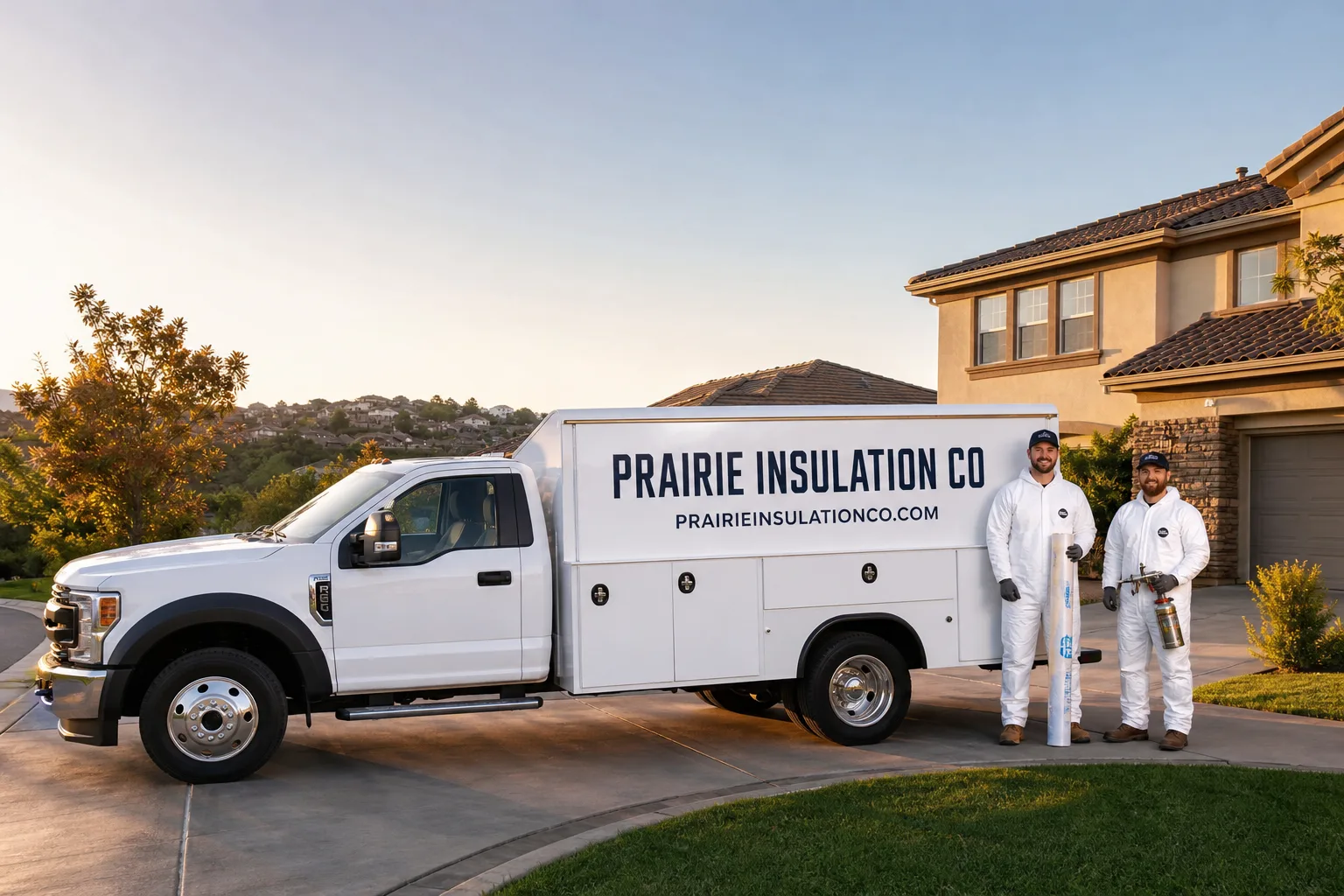
Spray Foam Insulation in Wildomar, CA: What It Costs and How It Fixes Legacy Attic Problems
Spray foam insulation in Wildomar typically costs $2.50 to $5.50 per board foot installed, with most whole-attic closed-cell jobs landing between $4,800 and $9,500 for the single-story homes common across 92595. We finish most Wildomar attic projects in one to two days, and we can usually have a crew at your home within a week of your call. If your house was built in the late ’80s through the 2000s, the attic is probably working against you every summer afternoon.
Wildomar sits in the hot inland valleys of southwest Riverside County, where July and August routinely push attic temperatures past 140 degrees. The cooling load, not the heating load, drives every insulation decision here. When we open an attic over a 1989 tract home off Clinton Keith Road or a custom place on a parcel near Grand Avenue, what we find is almost always the same: settled R-11 fiberglass batts that have pulled away from the top plates, leaving open gaps where superheated attic air pours straight into the living space. That is a Wildomar-specific problem, and spray foam is often the cleanest fix.
Call (855) 219-0368 for a free Wildomar estimate. Ken Sobecki and our team know exactly what these attics look like, because we have opened hundreds of them.
Key Takeaways for Wildomar Homeowners
- Closed-cell spray foam in a typical Wildomar attic runs $4,800 to $9,500, depending on square footage and access.
- Open-cell foam runs $2.50 to $3.50 per board foot and works well in vented attics where you’re air-sealing the floor.
- Most Wildomar homes built before 2005 have original insulation that settled years ago and no longer meets current Title 24 expectations.
- We cover all of 92595, including neighborhoods off Grand Avenue, Clinton Keith Road, and the newer tracts near The farm.
- Same-week scheduling is usually available for Wildomar jobs.
Fast, Reliable Spray Foam Insulation Across Wildomar
We work in Wildomar every week. Our crews know the drive from Ladera Ranch down the 15 and over to the 15/215 split, and we schedule Wildomar jobs first thing in the morning so we’re not pulling up at 4 p.m. with an attic that’s been baking all day. Response time matters here, because if your air conditioner is cycling nonstop and your upstairs bedrooms won’t hold temperature, waiting three weeks for a bid isn’t something you want to hear.
The houses we see in Wildomar break into two rough groups. There are the newer tract subdivisions, mostly built from the mid-1990s through the 2000s, where the attics got builder-grade fiberglass that looked fine on paper and underperformed from day one. And there are the older rural and semi-rural parcels, some going back to the ’80s, where the original insulation has compressed, been disturbed by rodents or remodels, or simply wasn’t enough to begin with. Both groups respond well to spray foam. The approach just differs.
Call (855) 219-0368 and we’ll tell you straight up what your attic needs, whether that’s Spray Foam Insulation or something else entirely.
Why Prairie Insulation Co Is Wildomar’s Preferred Spray Foam Insulation Company
We’re not a one-product contractor. We stock and install insulation from eight manufacturers, including Owens Corning, Johns Manville, and Rockwool, which means we don’t have a financial reason to push spray foam on an attic that would do better with blown-in cellulose. When we recommend closed-cell foam to a Wildomar homeowner, it’s because the math and the attic access say foam is the right call. That’s the whole job: matching the material to the house.
Ken Sobecki runs our spray foam crews personally, and he’s the one who built our approach to legacy Riverside County attics. The reason we keep getting called back to Wildomar is simple: we fix the gaps, not just the surface. A lot of insulation contractors will blow more fiberglass over settled batts and call it done. That doesn’t fix the heel gaps where the roof meets the top plate, and it doesn’t air-seal anything. In a 140-degree Wildomar attic, those gaps are the whole ballgame.
We also carry Icynene and Demilec spray foam systems, which gives us options for different roof deck and wall conditions. What gets specified for a vented attic floor is not always what a cathedral ceiling near Wildomar’s rural parcels needs. We’d rather explain the difference than sell one product to every house.
Closed Cell Spray Foam Insulation in Wildomar
Closed Cell Spray Foam Insulation in Wildomar is the option we recommend most often for homes with unvented attics, HVAC equipment in the attic, or roof decks that need structural air-sealing. It runs about $3.75 to $5.50 per board foot installed, so a 1,200-square-foot attic at 2 inches of foam typically lands between $6,500 and $9,000. It costs more than open-cell, but it delivers roughly R-7 per inch, acts as a vapor barrier, and seals the attic tight enough that conditioned air stops escaping through every top plate and chase penetration.
In Wildomar specifically, closed-cell foam is often the difference between an upstairs bedroom that holds 74 degrees in August and one that climbs to 82 by 3 p.m. That’s not marketing. That’s what happens when you stop hot attic air from bleeding into the living space through the framing. For the rural custom homes off Grand Avenue, closed-cell is also our go-to when the HVAC chase runs through the attic and you want the equipment inside the thermal envelope.
Roof Deck Applications
Spraying closed-cell foam directly onto the underside of the roof deck converts a vented attic into a conditioned, semi-conditioned, or unvented assembly. We do this on Wildomar homes where the attic holds HVAC ducts or the homeowner wants storage space that won’t cook everything in it. Two inches of closed-cell gives you about R-14 and an air seal that fiberglass can’t match.
Rim Joist Sealing
Older Wildomar homes leak at the rim joist, the band of framing where the floor meets the foundation. We spray closed-cell foam into those bays from the crawlspace or basement side, which stops hot exterior air from infiltrating the house in summer and keeps conditioned air in. This is a small job, often under $1,500, but it fixes a leak path most homeowners never see.
Open Cell Spray Foam in Wildomar
Open Cell Spray Foam in Wildomar is the more affordable option, running $2.50 to $3.50 per board foot installed. It’s a low-density foam that expands to fill the cavity, air-seals well, and delivers about R-3.7 per inch. We’ll specify open-cell when the attic floor is the target surface and the attic itself stays properly vented through baffled soffits and ridge or gable vents. In those conditions, it’s a genuinely good product at a lower price point than closed-cell.
But there’s a Wildomar-specific caveat. The older rural and custom parcels around 92595 often have soffit vent paths that were never baffled, and some have cathedral ceilings with no venting at all. In those assemblies, open-cell foam can trap moisture against the roof deck if no vapor strategy is planned. We rarely recommend open-cell directly against a roof deck in Wildomar because the hot-dry summer cycle can push moisture inward. On a vented attic floor, it’s a fine choice. On an unvented deck, closed-cell is usually the safer specification.
Attic Floor Air Sealing
When a Wildomar attic has working soffit vents and ridge vents, we’ll often recommend open-cell spray foam across the attic floor to seal all top plates, wire penetrations, and the gaps that settled batts left behind. The foam forms a continuous air barrier, and then we can blow insulation on top if the budget calls for a phased approach.
When to Choose Open-Cell
Open-cell is the right call when the primary problem is air leakage, not moisture, and the attic has a proper venting scheme. Budget is also a real consideration. A whole-attic open-cell job in Wildomar is usually $1,500 to $3,000 less than closed-cell on the same footprint, and it still fixes the summer comfort problem in most vented attics.
Trusted Brands We Service in Wildomar
Prairie Insulation Co installs spray foam from Icynene and Demilec, the two systems most specified by building scientists and energy auditors. We also carry Owens Corning and Rockwool products for homes where foam isn’t the answer, plus Johns Manville and Knauf fiberglass for standard batt and roll work. Because we install all of it, we can walk into a Wildomar attic and tell you honestly whether to foam, blow, or batt. That’s the advantage of eight brands and one crew: the recommendation comes from what the house needs, not what we happen to stock.
For Wildomar customers, having the right product available locally means we aren’t waiting on special orders. We keep Icynene and Demilec rigs stocked, and we carry both open-cell and closed-cell chemistries. If you need foam next week, we can usually make it happen.
Common Spray Foam Insulation Problems We See in Wildomar Homes
- Settled R-11 batts pulling away at the heel and knee walls. In Wildomar homes built from the late ’80s through the ’90s, the original fiberglass batts have compressed and separated from the framing. Spray foam has to seal those gaps, not just cover them, or the attic heat still bleeds through.
- Foam sprayed over an unsealed attic floor without baffling the soffit vents. We see this on older rural and custom parcels where a previous contractor foamed the attic floor but never installed baffles, which suffocated the attic ventilation and trapped heat. The fix is removing or trimming the foam at the eave edge and adding baffles before re-spraying.
- Unvented cathedral ceilings with the wrong foam chemistry. Some Wildomar custom homes have metal-framed or unvented cathedral assemblies. Open-cell foam sprayed directly against the deck can trap moisture in those conditions. We pull it out and re-spec closed-cell with the appropriate vapor strategy.
- Builder-grade attic insulation that never met current Title 24 levels. Most Wildomar homes built before the mid-2000s have attics in the R-11 to R-19 range. Title 24 now expects R-38 to R-49 in this climate zone. Spray foam won’t always hit that number by itself, but combined with air-sealing, it outperforms a deeper pile of fiberglass alone.
On a rural parcel off Grand Avenue, our crew opened an attic over a 1990-era custom home and found collapsed R-11 batts that had pulled away from the heel, letting the summer attic heat pour straight into the living space. We air-sealed the top plates and knee walls and applied closed-cell spray foam to the roof deck, so the HVAC chase stayed inside the thermal envelope. The homeowner reported the upstairs bedrooms finally holding temperature through an August afternoon. That’s the kind of fix this page is really about.
Pricing for Spray Foam Insulation in Wildomar, CA
A typical closed-cell attic job in Wildomar runs $4,800 to $9,500, and open-cell on the same footprint runs $2,800 to $5,500. Rim joist sealing, which we do on the older homes where the floor framing sits over open crawlspace, usually lands between $900 and $1,500. Garage ceiling spray foam, a smaller but high-impact job for attached garages that bake in the afternoon sun, runs $1,200 to $2,800 depending on joist depth and access.
What moves the price: attic height and access (crawl-in attics cost more in labor), how much old insulation we have to remove first, and whether the roof deck gets foamed in addition to the attic floor. We give Wildomar homeowners a written, line-item price before any work starts, so you’re not guessing when the invoice comes. Estimates are free. Call (855) 219-0368 and we’ll come out to 92595, walk the attic with you, and tell you what it’ll cost.
For more on how we approach this work across the region, see Spray Foam Insulation in Wildomar and the rest of our local coverage.
We Also Serve Cities Near Wildomar
Most of our Wildomar crews also cover Murrieta, Murrieta Hot Springs, Sedco Hills, and Lakeland Village, so if you’re on the edge of 92595 near any of those boundaries, you’re still in our regular service area. We schedule these jobs regionally, which keeps response times short for the whole southwest Riverside County corridor.
Serving Wildomar, CA — Our Local Coverage Area
We’re based in the Wildomar area and know this community well. Use the map below to see our service coverage — if you’re nearby, we can almost certainly help.
FAQs About Spray Foam Insulation in Wildomar
No. We pull the settled batts out first, because spraying foam over compressed R-11 leaves a void at the framing and does nothing for the heel gaps. The right sequence is removal, air-sealing the top plates and penetrations, then spraying foam directly onto the attic floor or roof deck. Call (855) 219-0368 and we’ll tell you what your attic needs after we see it.
If the attic is vented and you’re sealing the floor, open-cell usually works and saves you money. If the attic holds HVAC equipment or you’re spraying the roof deck, closed-cell is the safer call. In Wildomar’s 140-degree summers, the air seal matters more than the R-value per inch. Call us at (855) 219-0368 and we’ll spec it honestly based on your attic.
Yes, but start with the attic. In a hot-inland climate like Wildomar’s, heat enters from above first, not through the walls. Foam-sealing the attic makes a bigger difference than any wall work. For wall retrofits on those older parcels, we’ll recommend injection foam or blown-in products depending on the framing and the wall’s existing condition.
It can, and that’s exactly why we install baffles before spraying. Older Wildomar homes, especially the rural and custom parcels, often have soffit vent paths that were never baffled, which means a previous contractor may have already foamed over them. We repair that by removing the foam at the eave edge, installing baffles, and re-spraying. The attic has to breathe.
Title 24 requires attics in this climate zone to reach R-38 to R-49, which most older Wildomar homes don’t meet. Spray foam coupled with air-sealing can reduce the total R-value needed in some prescriptive paths because it eliminates the duct leakage and infiltration losses that fiberglass alone doesn’t address. We don’t guess at compliance. We measure and document it.
Written by Ken Sobecki, Owner at Prairie Insulation Co, serving Wildomar and the surrounding Riverside County communities.