
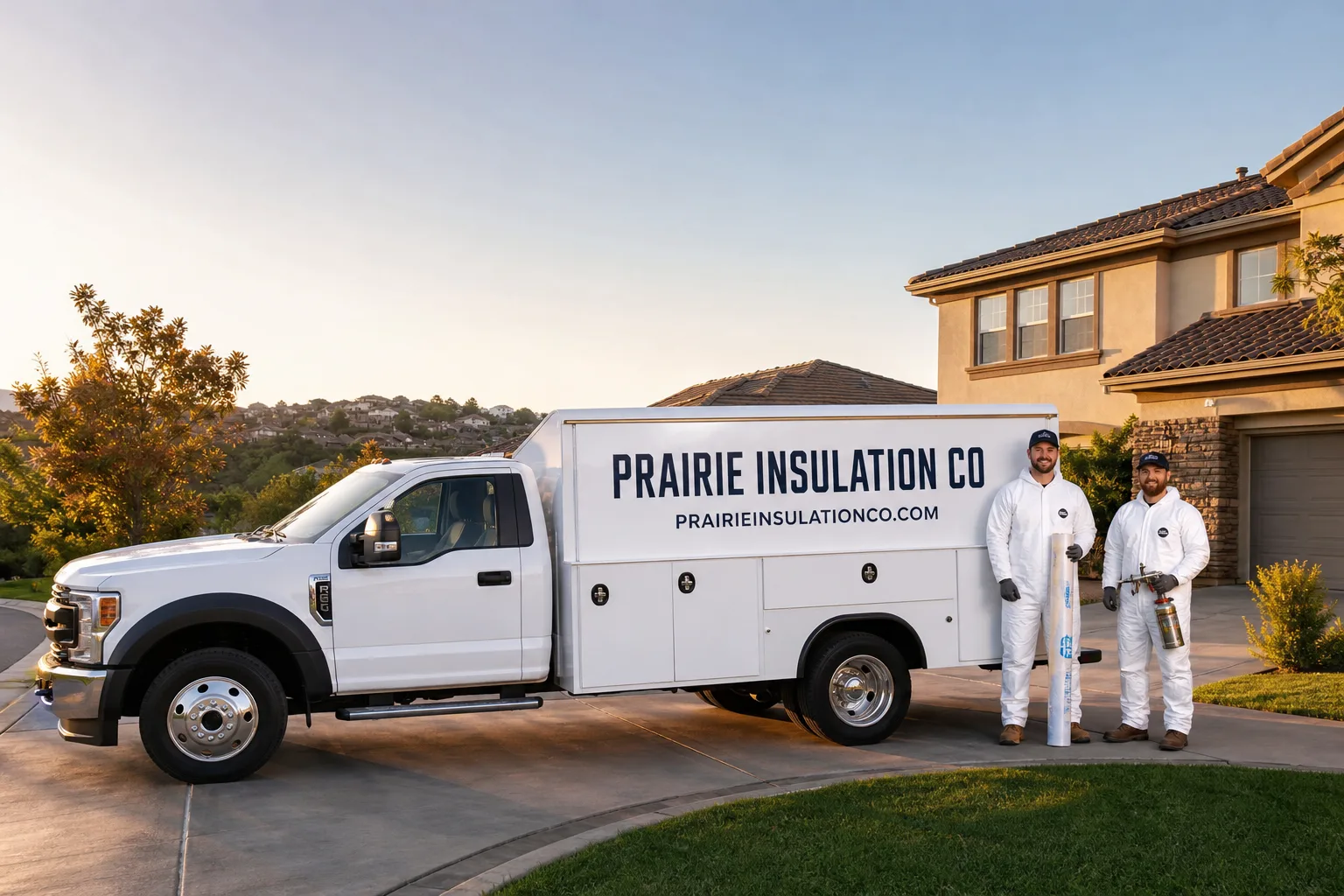
Fast, Reliable Spray Foam Insulation Across South San Jose Hills
Spray foam insulation in South San Jose Hills typically costs $3,100 to $6,200 for a standard attic application, and our crews reach most 91792 homes within one business day. The real question for homeowners here isn’t just cost. It’s whether the foam will hold up against the Santa Ana winds that scour attics along the hillside edges and the fine grit that pushes through every unsealed penetration near the valley floor. We’ve worked both sides of this ZIP code long enough to know they fail differently, and they need different solutions. Call (855) 219-0368 for a free estimate and we’ll tell you what your specific house actually needs.
Why Prairie Insulation Co Is South San Jose Hills’s Preferred Spray Foam Insulation Company
We’re material-agnostic by design. Prairie Insulation Co installs spray foam, attic batts, and blown-in insulation with equal comfort, because no single product does everything. Our crews work with eight manufacturer brands, including Icynene and Demilec for spray foam, which means when we recommend a product for your South San Jose Hills home, we’re recommending it because it matches the job, not because it’s the only thing we carry. That matters in 91792, where two houses a half-mile apart can need completely different approaches.
Ken Sobecki leads our team with a simple rule: specify the material first, then install it properly. That means if closed-cell spray foam against the roof deck is what your hillside-edge ranch needs to survive the next wind season, that’s what we recommend. If a flat-lot home near the valley floor needs top plates sealed with open-cell foam before blown insulation goes back over the ceiling, that’s what we recommend instead. We don’t have a brand quota to meet. We have attics to fix.
South San Jose Hills homeowners call us because we show up with the right product for their house, not a one-size pitch. Estimates are free, and most spray foam work in the area is completed in a single visit.
Spray Foam Attic Insulation in South San Jose Hills
Spray Foam Attic Insulation in South San Jose Hills has to solve a problem most contractors never even look for. In 91792, the dominant driver of comfort and energy loss isn’t just missing R-value. It’s the large day-night temperature swing that makes attic radiant heat brutal in summer, combined with Santa Ana wind events that push fine dust and grit through every crack in the attic floor. Spray foam works because it air-seals and insulates in one application, but only if the penetrations are sealed first around recessed lights, top plates, and the attic hatch itself.
A typical attic spray foam job in South San Jose Hills runs $3,100 to $6,200 depending on square footage and whether you’re sealing the roofline or the attic floor. Homes along the hillside edges of 91792 often need extra attention at gable and eave vents, where wind scouring has stripped away the original insulation.
Hillside-Edge Attics
The tract homes along the hillside edges of 91792 develop a specific failure pattern during Santa Ana events. Loose batts at gable and eave vents get scoured away, leaving bare top plates and open penetrations that let wind-driven dust pour into the living space. Spray foam applied against the roof deck at the wind-exposed end stops that scouring permanently, because it bonds to the surface instead of sitting loose. We then air-seal the top plates and any recessed-light cans before reinstating blown insulation over the flat ceiling.
Flat-Lot Attics and Compacted Batts
Homes near the valley floor deal with a quieter problem. The original 1950s-1970s batts above unsealed top plates have compacted and sagged over decades, leaving thermal voids that don’t show up on a casual glance. Spray foam fixes this by sealing the air leakage path first, then adding R-value where it actually does something. Without the air-seal step, new insulation just covers the same leaks.
Spray Foam Wall Insulation in South San Jose Hills
Spray Foam Wall Insulation in South San Jose Hills is typically handled two ways: as part of a whole-home air-sealing project, or as a targeted fix for specific rooms that won’t hold temperature. Most 91792 homes are 1950s-1970s wood-frame ranch construction on raised foundations, which means the wall cavities often contain mineral wool or early fiberglass that’s settled, compressed, or separated from the top plates. When those walls get spray foam, the foam fills the cavity completely, air-seals every gap, and stays in place permanently.
Wall spray foam in South San Jose Hills generally runs $2,800 to $5,500 for a typical single-story ranch, though prices climb if we’re doing rim joists and band boards at the same time. The raised-foundation design of most homes here makes rim joist work a natural pairing, since that’s where a significant share of the air leakage happens.
Wood-Frame Wall Cavities
Postwar wood-frame walls in South San Jose Hills are consistent: 2×4 framing, fiberboard sheathing in some cases, and insulation that was never meant to last 60 years. Open-cell spray foam works well in these cavities because it expands to fill irregular spaces and air-seals as it cures. Closed-cell foam adds structural strength and a vapor barrier, which matters on hillside-edge homes that take wind-driven moisture against the windward walls.
Rim Joists and Band Boards
Raised foundations mean accessible rim joists, at least in most crawlspaces. Sealing the rim joist zone with closed-cell spray foam stops a surprising amount of air leakage and keeps the first few feet of floor noticeably warmer in winter. In South San Jose Hills’s cool, occasionally frosty winters, that’s the difference between a floor you avoid in January and one you don’t notice.
Trusted Brands We Service in South San Jose Hills
We specify spray foam from Icynene and Demilec, two of the most respected open-cell and closed-cell systems in the industry. For homes where spray foam isn’t the right tool, we also work with Owens Corning and Johns Manville for batts, Rockwool where fire resistance and soundproofing matter, and GreenFiber cellulose for homeowners who want recycled-content performance. Eight brands, one crew. That means a South San Jose Hills homeowner gets the full spectrum of insulation technology, not the single line a generalist happened to buy. We stock the foam systems and accessories needed to keep a 91792 job moving without waiting on parts from out of state.
Common Spray Foam Insulation Problems We See in South San Jose Hills Homes
- Santa Ana wind scouring at gable and eave vents. Hillside-edge homes in 91792 lose loose insulation at these vents during wind events, leaving bare top plates and open penetrations. Spray foam bonded to the roof deck at the wind-exposed end stops the scouring cycle permanently.
- Compacted batts over unsealed top plates. Flat-lot homes near the valley floor accumulate sagging, compressed batts from decades of temperature swings and gravity. Sealing the top plates with foam before adding insulation is the only fix that addresses the air leakage feeding the comfort problem.
- Dust and grit pushing through attic hatch gaskets. Failed or missing hatch gaskets let fine airborne dust from the dry hills filter into living spaces during wind events. Foam-sealing the hatch perimeter and any recessed-light voids keeps that grit out of the house.
- Recessed-light voids acting as air chimneys. Older recessed cans in 1950s-1970s ranches leak conditioned air into the attic around the clock. Foam-sealing around the cans, or replacing them with IC-rated fixtures before foaming, closes that constant air leak.
Pricing for Spray Foam Insulation in South San Jose Hills, CA
Spray foam attic insulation in South San Jose Hills runs $3,100 to $6,200 for most single-story ranch homes. Wall cavity work runs $2,800 to $5,500. The spread comes down to square footage, foam type, and how much air-sealing prep the job needs. A hillside-edge home with wind-scoured vents and open top plates costs more than a flat-lot home with intact batts, because the prep work is heavier. That’s honest pricing, not a markup game. We give free estimates, and the number we quote is the number you pay. Call (855) 219-0368 and we’ll tell you what your specific home needs.
One thing we’ll say plainly: you can find cheaper spray foam bids in the San Gabriel Valley. What you usually lose is the air-sealing step, which is where the actual performance lives in a 91792 attic. Foam without sealing is just expensive insulation covering the same leaks.
We Also Serve Cities Near South San Jose Hills
Our crews regularly run spray foam jobs in Spray Foam Insulation in South San Jose Hills and the surrounding foothill-edge communities. We serve Walnut, Rowland Heights, Hacienda Heights, and Pomona with the same material-agnostic approach and the same one-trip focus. If you’re just over the line from 91792, the drive is short and the estimate is still free. Our Spray Foam Insulation team covers the whole eastern San Gabriel Valley.
Serving South San Jose Hills, CA — Our Local Coverage Area
We’re based in the South San Jose Hills area and know this community well. Use the map below to see our service coverage — if you’re nearby, we can almost certainly help.
FAQs About Spray Foam Insulation in South San Jose Hills
Your attic is losing insulation at those vents because Santa Ana wind events physically scour loose batts away from the openings, leaving bare top plates and open penetrations. This is a hillside-edge pattern we see regularly in 91792, and the fix is spray foam bonded to the roof deck at the wind-exposed end, which the wind can’t move. Call (855) 219-0368 and we’ll confirm whether your attic is a wind-scour case or a compaction case.
Yes, but the spray foam’s main job in this situation is sealing the top plates, not just adding R-value. Compacted batts over unsealed top plates mean air has been leaking past the insulation for decades, and foam applied at the top plates stops that air path before new insulation goes back over the ceiling.
It’s designed for exactly that. Inland valley and foothill locations like South San Jose Hills see large day-night temperature swings that make attic radiant heat the dominant comfort problem in summer, and closed-cell spray foam against the roof deck cuts that radiant transfer substantially. It also holds the attic closer to indoor temperature, which keeps your ductwork from baking all afternoon.
Yes, and we do this on every job. Recessed-light voids and attic hatch gaskets are the two biggest air-leak paths in postwar ranch homes, and in South San Jose Hills’s dry wind conditions they also let fine grit into the house. Foam-sealing those penetrations before the main application is standard procedure for us, not an add-on.
It depends on your walls and your goals. Wood-frame walls from the 1950s-1970s typically have settled or compressed insulation, and open-cell spray foam fills those cavities completely while air-sealing every gap. If your main complaint is uneven room temperatures or a room that won’t hold heat in winter, wall foam usually addresses it directly. Call (855) 219-0368 for a free assessment and we’ll tell you what your specific house needs.
Written by Ken Sobecki, Owner at Prairie Insulation Co, serving South San Jose Hills and the surrounding San Gabriel Valley foothill communities.