
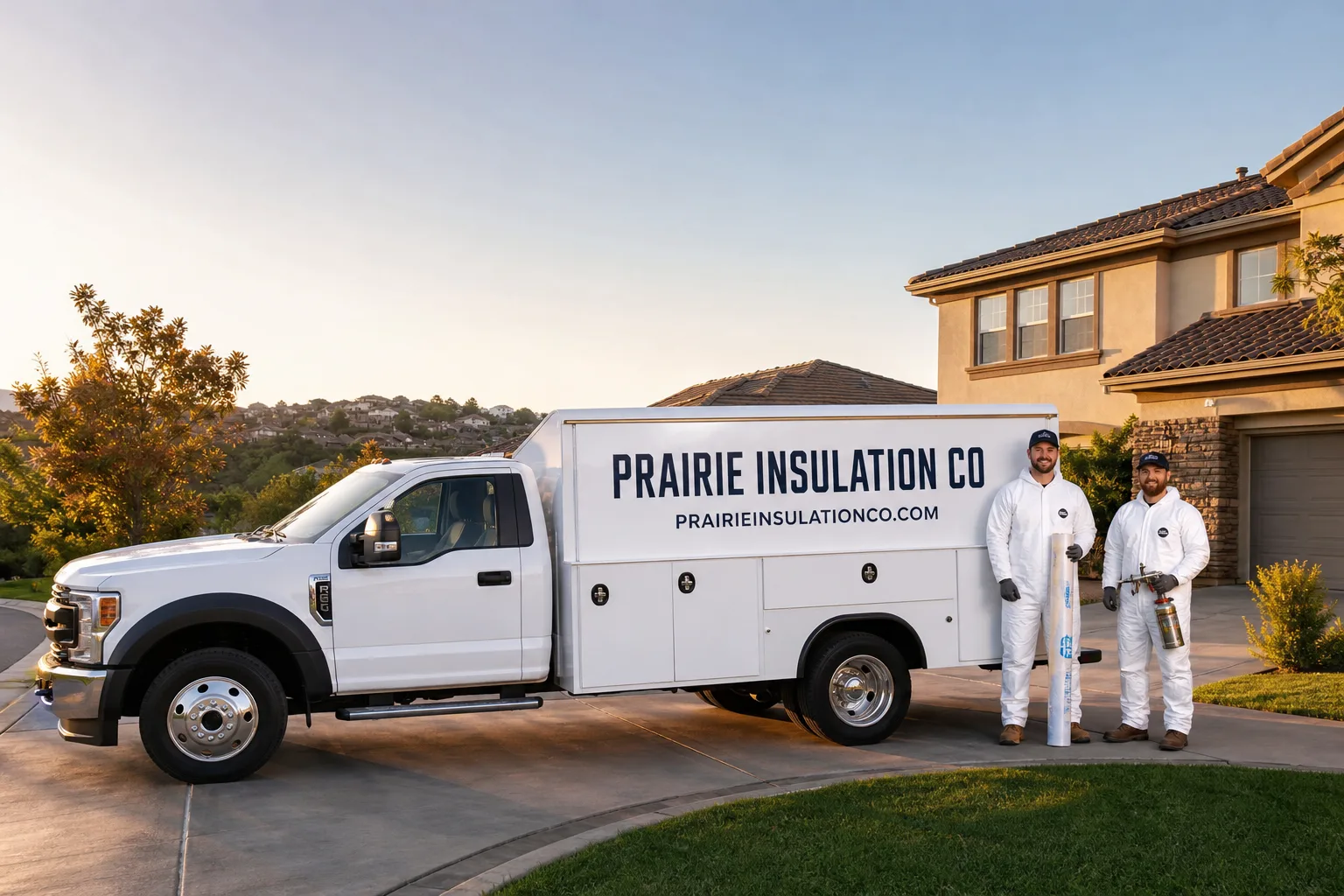
Fast, Reliable Spray Foam Insulation Across Glen Avon
Spray foam insulation in Glen Avon usually costs between $1.80 and $4.50 per board foot depending on whether we’re using open-cell or closed-cell chemistry, and most attic jobs in the 92509 corridor run $2,900 to $6,800 all-in. We work the Jurupa Valley corridor every week, so we know what these older ranch homes and mobile homes need. If your attic is cooking at 130°F in July and your AC can’t keep up, the problem isn’t your HVAC unit – it’s what’s between your roof deck and your ceiling. Call Prairie Insulation Co at (855) 219-0368 and we’ll tell you straight what your house actually needs.
Why Prairie Insulation Co Is Glen Avon’s Preferred Spray Foam Insulation Company
We carry eight insulation brands – Owens Corning, Johns Manville, Knauf, Rockwool, CertainTeed, Icynene, Demilec, and GreenFiber – which means we specify the right chemistry for Glen Avon’s specific heat problem rather than pushing whichever product we happen to stock. Most insulation contractors in Riverside County install one brand. We install what the science calls for. Ken Sobecki built this company around that principle: match the material to the house, not the house to the material.
Glen Avon homeowners call us because we understand the 92509 housing stock. Mid-century ranch homes with original attics. Mobile homes in the unincorporated pockets. Detached workshops on acreage lots. Each one needs a different approach, and we’ve been through enough attics off Mission Boulevard to know exactly what we’ll find before we open the hatch.
Our crews respond to Glen Avon service calls typically within one to two business days. When you call for a free estimate, we schedule the site visit at a time that works – and for attic foam work, we’ll recommend early morning anyway, because that’s when your roof deck is cool enough for proper adhesion.
Spray Foam Attic Insulation in Glen Avon
Spray foam attic insulation is the highest-impact fix for Glen Avon homes where attic temperatures routinely exceed 130°F between June and September. Most of the ranch and tract homes along the 92509 corridor were built in the 1950s through 1970s with thin fiberglass batts that have since flattened to an inch or less, leaving your ceiling plane with almost no resistance to radiant heat gain. We typically recommend closed-cell foam at two inches of depth for roof deck applications in Glen Avon, which runs $3.20 to $4.50 per board foot. That gives you an air seal plus an R-value of roughly 14 on the deck itself, which drops attic temperatures dramatically and stops your ducts from sweating.
Open-cell foam costs less – usually $1.80 to $2.60 per board foot – and works well in vented attics where the roof deck isn’t the primary thermal boundary. But in Glen Avon’s unvented or poorly vented attics, we don’t recommend open-cell applied directly to a hot roof deck. The heat here pushes open-cell past its useful temperature range. We’ll tell you which one your attic actually warrants after we look at it.
Early-Morning Scheduling for Attic Work
Attic surfaces in Glen Avon climb fast once the sun clears the Jurupa Hills. By 10 a.m. in July, a roof deck can be too hot to touch. We schedule foam application for first light, when sheathing temperatures are still low enough for proper adhesion and curing. It’s a small scheduling detail that prevents blistering and delamination down the road.
This matters more in Glen Avon than in coastal cities. We’re inland. We get the full Riverside County sun with no marine layer to soften it.
Duct Sealing in the Attic
Homes in Glen Avon with ducts running through the attic lose a staggering amount of conditioned air before it ever reaches the bedroom. We routinely find duct boots and seams leaking 130°F attic air into the system. When we spray attic foam, we also seal the top plates, wire penetrations, and duct connections – because foam without air sealing is only half the job.
Spray Foam Wall Insulation in Glen Avon
Spray foam wall insulation in Glen Avon addresses the wall cavities of older stucco tract homes that were built with nothing but a thin layer of fiberglass – or sometimes nothing at all. In the 1960s and 70s ranch homes off Mission Boulevard, the wall assembly was often just stucco over frame with no continuous insulation, which is why your interior walls feel warm to the touch on summer evenings. We install both open-cell and closed-cell spray foam in walls here, and the cost typically runs $2.10 to $3.80 per square foot of wall area depending on stud depth and access.
For most Glen Avon retrofits, we access wall cavities from the exterior by removing a band of stucco or siding at each stud bay. It’s precise work, and it’s worth doing right because a botched wall foam job means gaps and voids that let heat through anyway. We use Icynene open-cell foam for walls in homes that need breathability and Demilec closed-cell foam where moisture control or added structural rigidity matters.
Mobile Home Wall Systems
Mobile homes in Glen Avon’s unincorporated pockets have their own set of wall problems. Thin wall cavities, aluminum or vinyl exterior panels, and older vapor barriers that trap moisture. We approach these differently than traditional framing – usually a low-expansion open-cell formulation that won’t bow the exterior skin. The result is an interior that holds temperature and a wall assembly that doesn’t sweat.
Workshop and Garage Walls
Detached workshops and garages on Glen Avon acreage lots are where we do a lot of closed-cell wall work. These structures run unconditioned, unvented, and hot enough to ruin tools and warp lumber. Closed-cell foam at two to three inches in the wall cavities, plus an ignition barrier where code requires it, changes the inside temperature by a noticeable margin and keeps the space usable through the hottest months.
Trusted Brands We Service in Glen Avon
We install spray foam systems from Icynene and Demilec – two of the brands most specified by building scientists and energy auditors for hot-climate applications. We also carry Johns Manville, Knauf, Rockwool, and CertainTeed for complementary work like attic blow-in, wall batts, and mineral wool applications where fire resistance or acoustic performance is the priority. Because we stock and install across eight manufacturers, our Glen Avon customers get a recommendation that fits their house, not a sales pitch for whatever’s on the truck. If your attic needs closed-cell foam on the roof deck but mineral wool in the walls, we do both. One crew, one trip, one accountable contractor.
Common Spray Foam Insulation Problems We See in Glen Avon Homes
Glen Avon’s heat, dust, and older construction create specific failure modes we see over and over. Here’s what goes wrong and how we avoid it:
- Foam delaminating from dusty or oil-stained sheathing. Attics in 60-year-old Glen Avon homes have decades of dust, soot, and sometimes oil residue from old evaporative coolers. Foam will not adhere to that. We clean and prep every surface before spraying – skip that step and the foam peels off within a season.
- Open-cell foam off-gassing in attics that exceed 130°F. This is a real problem in the 92509 corridor. Standard open-cell foam applied directly to a hot roof deck can degrade and give off an odor that never quite goes away. We specify closed-cell foam for those assemblies and schedule the work for early morning.
- Missing ignition barriers on exposed foam in attached garages and workshops. Glen Avon has a lot of detached garages and acreage workshops. Exposed foam without a thermal or ignition barrier is a fire hazard under code. We install the required covering – often an intumescent coating or drywall – as part of the job.
- Foam sprayed over existing fiberglass without removing it first. This is common in Glen Avon’s older homes where someone threw batts down 30 years ago and then wanted foam on top. Foam over loose, dusty fiberglass doesn’t form a proper air seal. We remove the old material, assess the sheathing, and spray onto a clean substrate.
Pricing for Spray Foam Insulation in Glen Avon, CA
For a typical 1,200 to 1,800 square foot Glen Avon ranch home, a full attic spray foam job – roof deck plus gable walls – runs $3,800 to $6,800 using closed-cell foam. Wall retrofit work on the same house usually adds $2,100 to $3,800 for exterior-access open-cell installation. A detached workshop or two-car garage ceiling typically runs $1,400 to $2,600 to foam the underside of the roof deck with closed-cell. Factors that change the price: access (vaulted ceilings, tight attics, low slope), the condition of existing insulation, and whether ignition barriers are required by code. We give you an exact quote before any work starts, and it’s free. Call (855) 219-0368 to schedule.
We Also Serve Cities Near Glen Avon
If you’re outside Glen Avon proper, we run crews through the surrounding area regularly. We serve Pedley, Sunnyslope, Rubidoux, and Riverside with the same material-agnostic approach and the same early-morning attic scheduling we use here. If you’re anywhere in the Jurupa Valley corridor, our Spray Foam Insulation team can quote your project and usually have a crew on site within the week.
Serving Glen Avon, CA — Our Local Coverage Area
We’re based in the Glen Avon area and know this community well. Use the map below to see our service coverage — if you’re nearby, we can almost certainly help.
FAQs About Spray Foam Insulation in Glen Avon
Yes – it’s the single most effective retrofit for Glen Avon’s summer heat problem because it addresses attic radiant gain directly. Closed-cell foam on the roof deck reflects and blocks heat before it enters the attic, keeps your ducts from cooking, and lets your AC actually cycle normally. Most Glen Avon customers who foam their attics report back bedrooms cooling evenly for the first time in years. Call (855) 219-0368 for a quote specific to your house.
Closed-cell foam is best for attic roofs and unvented assemblies in Glen Avon because it handles the 130°F+ deck temperatures without degrading. Open-cell works well in wall cavities and vented attics where heat isn’t as extreme. For mobile homes, we usually specify a low-expansion open-cell formulation that won’t bow thin exterior skins. Ken Sobecki can walk you through the recommendation after seeing your home.
We treat detached workshops and garages as their own thing – not just a smaller attic. That means closed-cell on the roof deck for heat rejection, wall cavity foam where the framing allows, and ignition barriers over any exposed foam as required by code. Call (855) 219-0368 and we’ll walk your building and tell you what it needs.
No – closed-cell foam applied to the roof deck creates an unvented attic assembly, which is often the right approach for Glen Avon homes because it keeps the attic out of the 130°F range entirely. If you’re keeping your attic vented, we use a different approach. The short answer: ventilation requirements depend on which foam chemistry we specify and where we apply it, and we’ll explain that decision for your specific roof before we start.
No. Foam needs a clean substrate to adhere properly. In Glen Avon’s older homes, that usually means removing the flattened fiberglass or old cellulose first, cleaning the sheathing, and then spraying onto bare decking or wall studs. Applying foam over dusty or oil-stained surfaces is exactly how we end up called back to fix delamination. We remove, prep, and then spray – in that order. Call (855) 219-0368 for a free estimate that includes any removal work.
Written by Ken Sobecki, Owner at Prairie Insulation Co, serving Glen Avon and the Jurupa Valley corridor.