
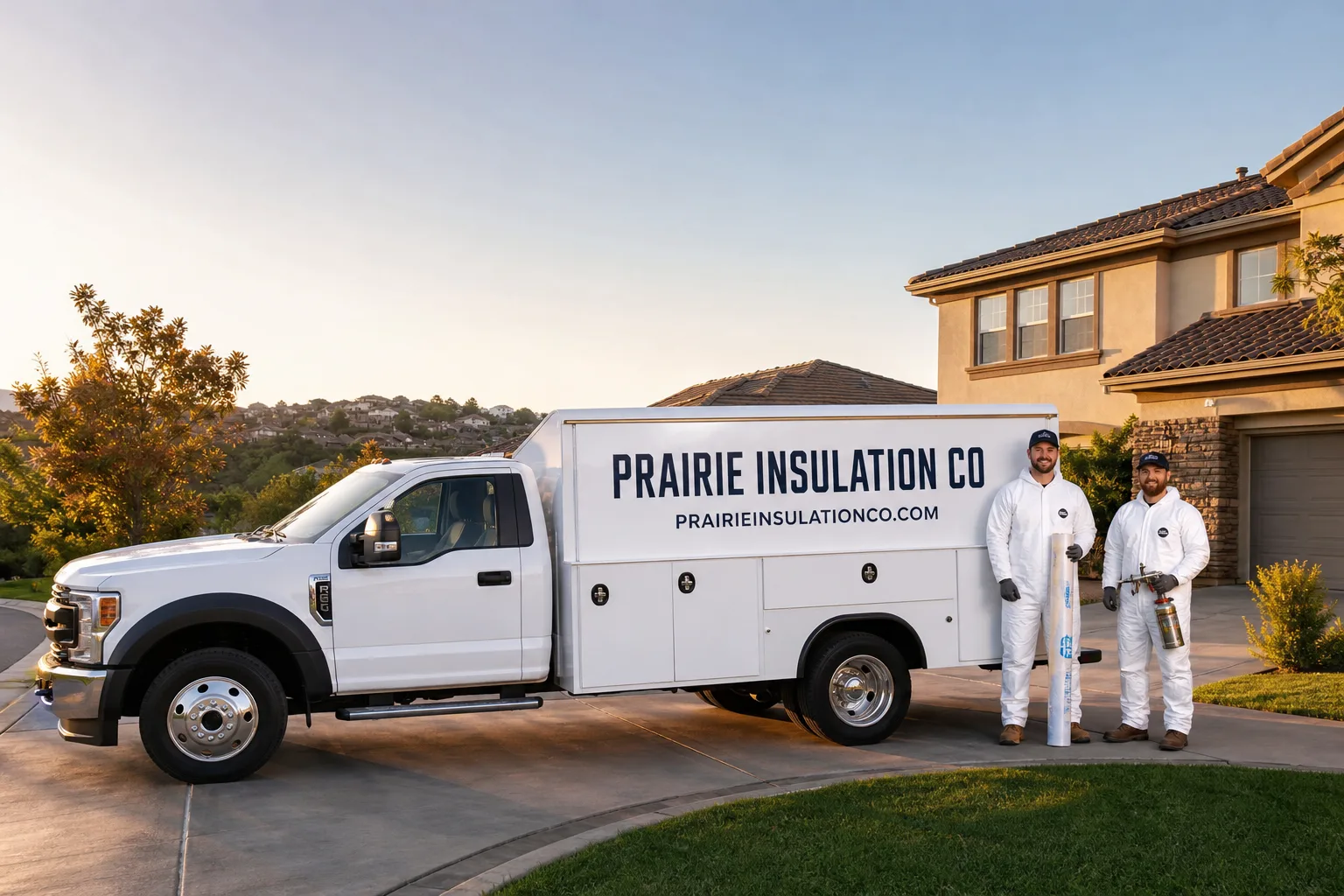
Fast, Reliable Attic Insulation Across Lakewood
Most Lakewood homes were built between 1950 and 1953, and most of those original attics still have a thin skim of mineral wool, or nothing at all. That means your attic is working against you every warm afternoon, and the fix is usually faster than people expect. We run crews into Lakewood neighborhoods like Mayfair, Carson Park, and the Lakewood Mutuals tract weekly, and we can usually have a full attic upgrade done in one day. Call (855) 219-0368 for a free estimate and we’ll tell you exactly what’s in your attic before we quote a dollar figure.
Why Prairie Insulation Co Is Lakewood’s Preferred Attic Insulation Company
Lakewood gave us something no other city can: a chance to learn one set of houses really, really well. Because this was one of America’s first postwar planned communities, most homes share the same handful of floor plans, the same 2×4 wall cavities, the same shallow attic joist bays. We know those attics block by block. When a homeowner on Hardwick Street calls, we already know what we’ll find before we open the hatch. That’s not a guess. That’s repetition.
Our techs have insulated hundreds of Lakewood attics, from the original Lakewood Park tract up through the 1960s infill near the Long Beach border. The reviews from Lakewood customers keep coming back to the same points: we show up when we say we will, we keep the job site clean, and we don’t push a brand just because it’s the one we happen to sell. We stock eight manufacturers’ products, so the recommendation matches the house, not our inventory sheet.
Response time to most Lakewood zip codes is same-day or next-day for estimates, and emergency calls for things like a failed insulation job that’s letting heat pour in can often be scheduled within 24 hours. Call (855) 219-0368 and ask for Ken. He’ll tell you straight what your attic needs and what it doesn’t.
Insulation Contractors in Lakewood
Insulation Contractors in Lakewood work on a unique set of constraints that contractors in newer cities never see. The work involves assessing the existing attic depth, checking for knob-and-tube-era wiring that cannot be buried, air-sealing the top plates and penetrations, and then installing the right material at the right R-value for a 1950s vented attic. When a Lakewood homeowner notices rooms that won’t hold temperature or a second floor that bakes by 3 p.m., the insulation is usually the first place we look. Here’s what to know before you hire anyone.
Depth Check Before Top-Up
If your attic has an old mineral-wool layer that’s settled to an inch or two, you can’t simply blow new insulation over it and call it done. The joist bays in these original tract homes are shallow, and the existing material has to be measured, checked for moisture, and sometimes removed partially before new loose-fill goes in. We see this specific condition in Lakewood more than anywhere else we work.
Wiring-Aware Blow-In
Knob-and-tube-era conductors are common in the 90712 and 90713 corridors, and loose-fill insulation must be dammed and kept clear of them. A crew that doesn’t look first is a liability. We’ve done enough Lakewood attics that identifying old wiring is step one before a single bag of GreenFiber comes off the truck.
Attic Ventilation in Lakewood
Attic Ventilation in Lakewood is tied directly to the marine layer and the Santa Ana pattern. When the Santa Anas blow, a poorly vented original attic turns into an oven, and that heat pushes down into the living space below, making the whole west end of the house uncomfortable by late afternoon. We usually top out an insulation upgrade with a ventilation check: soffit vents, a clear path from intake to exhaust, and ridge or gable vents that actually move air. Lakewood homes with original vented attics need both insulation and airflow, not one or the other.
Marine Layer Moisture Control
The cool, damp mornings that roll in off the coast settle into attics that lack proper cross-ventilation. We’ve pulled down too many Lakewood attic hatches and found damp fiberglass batts with mold starting at the eaves. Adding insulation without fixing the ventilation makes that problem worse, not better, and we’ll tell you so before we add material.
Santa Ana Heat Gain
During a Santa Ana event, attic temperatures in uninsulated Lakewood tract homes can climb past 140 degrees. That heat soaks through the ceiling and works against your air conditioning all afternoon. Pairing deep insulation with improved ventilation cuts that heat gain at its source. We specify both on most Lakewood retrofits because the original design never anticipated this kind of heat load.
Trusted Brands We Service in Lakewood
We install products from eight manufacturers, which matters in Lakewood because the right material for a 1950s shallow-bay attic isn’t necessarily the right material for a 1970s addition off the back of the house. For most original Lakewood attics, we specify GreenFiber cellulose: it settles into old joist bays cleanly, works around the wiring, and gives a real R-value boost without tear-out. For wall cavities, Owens Corning fiberglass batts or Rockwool mineral wool both fit the original 2×4 framing. We also carry Johns Manville and Knauf for specific retrofit conditions. We stock these materials locally and can usually turn around a full Lakewood install within a few days of the estimate.
Common Attic Insulation Problems We See in Lakewood Homes
- Settled mineral wool from the 1950s: The original insulation in many Lakewood tract attics has compressed to an inch or less, which gives almost no thermal resistance. We measure it before recommending any top-off.
- Uninsulated exterior walls: Most original Lakewood homes have empty 2×4 wall cavities, and attic insulation alone cannot solve that heat gain. Wall-cavity retrofits are part of the conversation here, not an afterthought.
- Knob-and-tube wiring conflicts: Old wiring runs through many Lakewood attic joist bays, and loose-fill insulation has to be dammed away from these conductors. A careless blow-in is a fire risk. We don’t do careless.
- Underventilated original attics: The 1950s vent designs are undersized for modern heat loads and the marine layer moisture pattern. We often find damp sheathing and early mold at the eaves that has to be addressed alongside the insulation work.
Pricing for Attic Insulation in Lakewood, CA
For a standard 1,100 to 1,400 square foot Lakewood tract home, you’re looking at these ranges: a top-up over existing material typically runs $0.90 to $1.40 per square foot, a full attic replacement runs $1.50 to $2.50 per square foot, and a deep retrofit with air-sealing and ventilation correction runs $2.80 to $4.00 per square foot. Wall-cavity insulation, when we do it, is usually $1.80 to $3.00 per square foot of wall area. These numbers reflect Lakewood’s specific housing stock: shallow joist bays, old wiring, and the need for careful air-sealing before any material goes down. Call (855) 219-0368 for a free estimate. Ken will walk you through the options and give you an exact number based on your specific floor plan.
We Also Serve Cities Near Lakewood
Our crews cover the full Lakewood area and the surrounding communities. We regularly work in Signal Hill, Long Beach, Hawaiian Gardens, and Artesia, and we know the housing patterns in each. For the full picture of our Attic Insulation services, or to see how we approach Attic Insulation in Lakewood specifically, we’ve put together detailed pages for the whole region.
Serving Lakewood, CA — Our Local Coverage Area
We’re based in the Lakewood area and know this community well. Use the map below to see our service coverage — if you’re nearby, we can almost certainly help.
FAQs About Attic Insulation in Lakewood
Yes, but only if the existing wiring is identified and dammed first. We inspect every attic for knob-and-tube-era conductors before any loose-fill goes in, and we build containment barriers around anything that cannot be covered. In Lakewood this is standard practice for us, not a special request. Call (855) 219-0368 to schedule an attic inspection, and we’ll tell you exactly what’s up there.
No, attic insulation only addresses the ceiling. Your original Lakewood exterior walls are 2×4 cavities with no insulation, and until those are filled, the west-facing rooms will keep heating up on warm afternoons. We do both attic and wall-cavity retrofits, usually in the same visit. The good news is that because Lakewood’s floor plans repeat, we already know exactly what those wall cavities look like before we open them.
Most Lakewood attic upgrades run between $1,000 and $3,000 depending on the attic size, the existing material, and whether we need to do air-sealing or ventilation work at the same time. A simple top-up in a 1,200 square foot tract home might be on the lower end, while a full replacement with wiring dams and ventilation correction will push the higher end. Free estimates: call (855) 219-0368.
Yes, the smart opener retrofit is a separate issue from the attic insulation itself, but it comes up constantly in Lakewood because the original garage doors are builder-grade and underperform. We’ve seen plenty of these doors on the original tracts, and the opener swap is straightforward. While we have the hatch open for the attic work, it’s an easy add-on. Ask Ken about it when you call (855) 219-0368.
Yes, and this is where some contractors get it wrong. Lakewood’s original vented attics were designed for a different climate, and adding insulation without addressing ventilation will trap heat and moisture. The marine layer brings damp mornings, and the Santa Anas bring extreme heat. Both conditions require moving air. We include a ventilation assessment with every Lakewood insulation quote, and in most cases we recommend adding soffit or gable ventilation alongside the insulation.
If you’re in Lakewood and your attic still has the original 1950s insulation, or none at all, we can fix it. Call (855) 219-0368 for a free estimate. Ken Sobecki leads our crew, and he’ll give you a straight answer about your attic, your walls, and your options.
Written by Ken Sobecki, Owner at Prairie Insulation Co, serving Lakewood and the surrounding LA Basin communities.