
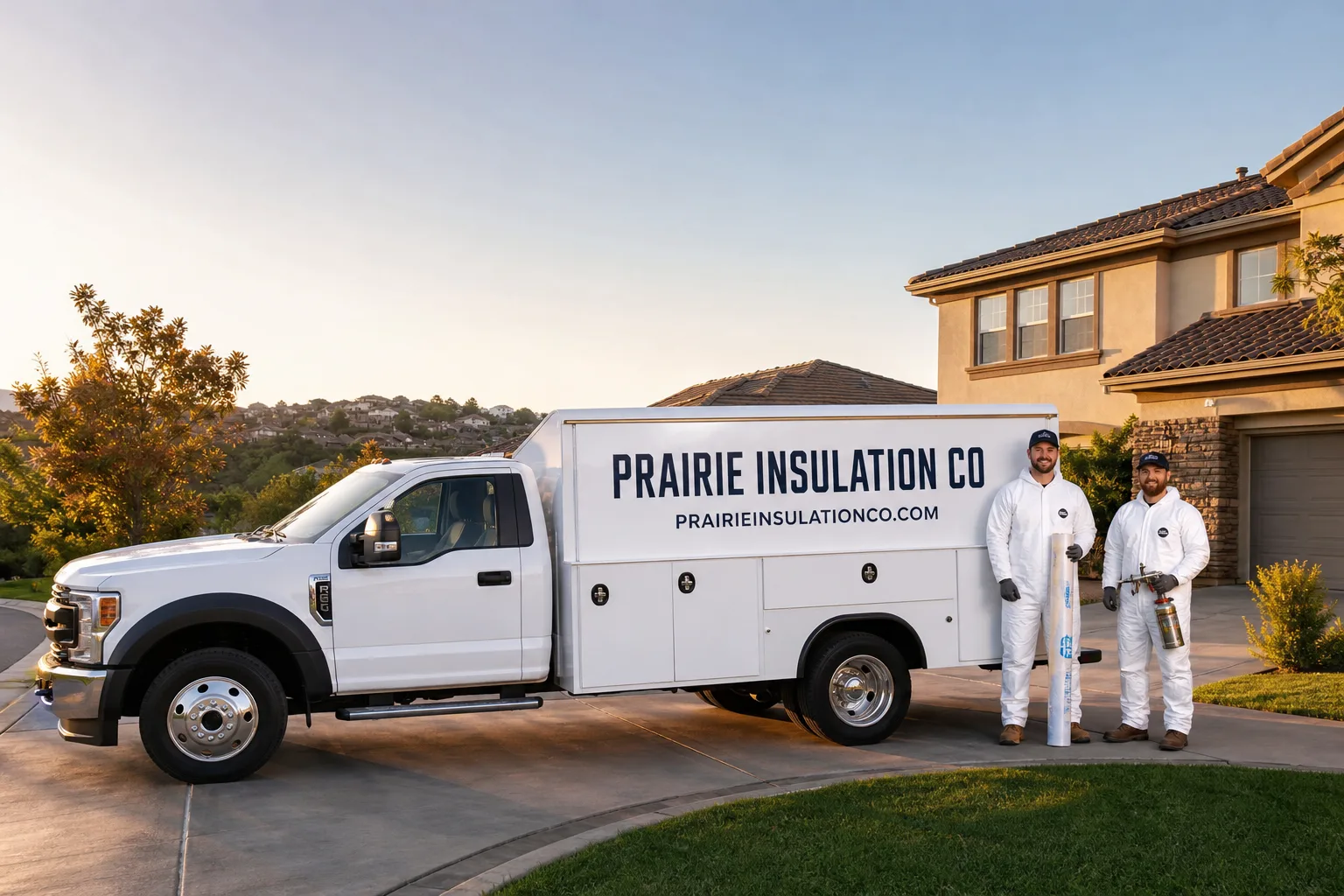
Fast, Reliable Attic Insulation Across Fountain Valley
Fountain Valley homes, most built in the 1960s and 70s, were never insulated for the coastal marine layer that rolls through every morning. The original R-11 batts those tract homes got are thin by today’s standards, and decades of fog-laden onshore wind have pushed many of them back from the eave line. We retrofit those attics properly. If you’re noticing cold spots near exterior walls, upstairs rooms that won’t hold temperature, or condensation on ceiling drywall, call Prairie Insulation Co at (855) 219-0368. We know this housing stock because we work in it weekly, from the tracts near Mile Square Park to the neighborhoods off Ellis and Nile in ZIP codes 92708 and 92728.
Why Prairie Insulation Co Is Fountain Valley’s Preferred Attic Insulation Company
Fountain Valley homeowners call us because we don’t push one insulation product. We carry eight manufacturer lines, including Owens Corning and GreenFiber, and we specify the material that fits the attic we’re standing in, not the one that’s easiest to quote. That matters in Fountain Valley, where the real problem is rarely total R-value. It’s eave-line batt displacement, trapped moisture, and ventilation that never worked right in the first place. We see it in the single-story stucco tracts off Magnolia, the two-story models near Talbert, and everywhere in between.
Ken Sobecki, who leads our attic insulation work, has spent enough time in Fountain Valley attics to know what the original 1960s installers got right and what they got wrong. He’ll tell you straight: adding blown-in cellulose over collapsed, wind-shifted batts doesn’t fix the perimeter gap. The fix is removing what’s failed, air-sealing, and installing the right material at the right depth. That’s the difference between an estimate that sounds cheap and an attic that actually performs. Call (855) 219-0368 and we’ll start with a real look at your attic, not a phone quote for a number that won’t solve anything.
Attic Ventilation in Fountain Valley
Attic Ventilation in Fountain Valley isn’t an optional upgrade, it’s the difference between an attic that stays dry and one that grows mold on the sheathing. The marine layer here means mornings start damp, and salty onshore air moves through soffit vents constantly. When original batts block those vents, or when there’s no ridge vent to balance intake, the attic turns into a moisture trap. A proper ventilation retrofit in Fountain Valley typically runs $450 to $1,150 depending on attic size, roof configuration, and whether we’re adding baffles, ridge venting, or both.
Eave Baffles and Vent Clearance
Most Fountain Valley tract attics have soffit vents that were fine when the house was built, before insulation settled and shifted. Restoring the intake path means installing baffles at every eave, keeping the soffit channels clear so air can move from the lower attic edge up to the exhaust opening.
Ridge and Exhaust Venting
A balanced attic needs as much intake as exhaust. On Fountain Valley’s pitched composition roofs, we commonly add ridge venting or upgrade existing static vents, sized to the attic’s square footage and the home’s orientation to the prevailing onshore breeze.
Radiant Barrier in Fountain Valley
Radiant Barrier in Fountain Valley works differently than it does in, say, Anaheim or Yorba Linda. Mild summers mean radiative gain isn’t the dominant cooling load, but the same marine-layer humidity that keeps temperatures moderate makes condensation control on the roof deck a real concern. A radiant barrier stapled to the underside of the rafters, or laid over the attic floor, can still cut afternoon heat transfer on those clear Santa Ana days. Installed in Fountain Valley, a radiant barrier for a typical 1,200 to 1,800 square foot attic runs roughly $900 to $2,200, depending on whether we’re doing just the floor or the complete rafter deck.
Roof-Deck Radiant Barrier
Stapling a reflective foil barrier to the underside of the rafters reflects heat before it reaches the attic floor. In Fountain Valley’s low-slope tract attics, this is a practical upgrade when we’re already in the space for insulation replacement, because the marginal labor cost drops significantly.
Floor-Laid Radiant Barrier
Laid over existing insulation, a floor-installed radiant barrier can help an older Fountain Valley attic, but it must be a vapor-permeable product so moisture isn’t trapped against the insulation below. We’re careful about this in Fountain Valley specifically, where condensation risk from the marine layer is higher than inland.
Trusted Brands We Service in Fountain Valley
We’re authorized to install Owens Corning, Johns Manville, Knauf, CertainTeed, Rockwool, Icynene, Demilec, and GreenFiber. In Fountain Valley, we keep the materials that make sense for this housing stock on hand: R-38 fiberglass batts for open attic floors, GreenFiber cellulose for blown-in top-ups where access is tight, and Owens Corning batts common to tract-home retrofits. Because we’re doing multiple Fountain Valley attics every week, we don’t have to order from a distant supplier when your job starts. The material is ready, which means fewer days between estimate and installation. For spray foam work, we use Icynene and Demilec systems, both well-specified by energy auditors for air-sealing older wood-frame construction like you find throughout Fountain Valley.
Common Attic Insulation Problems We See in Fountain Valley Homes
- Wind-shifted original batts. The fog-laden onshore breeze pushes through soffit vents for decades, and the original R-11 batts creep back from the eave line. The outer two to three feet of the ceiling plane ends up with no insulation at all, even though the attic center looks covered.
- Damp sheathing and condensation staining. Fountain Valley’s coastal marine layer means morning moisture gets into the attic through those exposed eave gaps and tanks of cooler air. Over time, that moisture shows up as dark staining on the roof deck or, worse, mold on the underside of the roof sheathing.
- DIY top-ups over settled insulation. We often see homeowners who added a fresh layer of batts over old, compressed insulation, using whatever was on sale at the home center. The result is uneven R-value, compressed air pockets, and trapped moisture against the ceiling drywall.
- Blocked or sealed attic access on old garage-door tracts. Some 1970s Fountain Valley homes have one-piece garage doors with aging openers, and when that hardware fails, the attic access hatch above the garage gets sealed or blocked. That cuts off access for the ventilation inspection and insulation work the attic needs.
Pricing for Attic Insulation in Fountain Valley, CA
Fountain Valley attic insulation prices reflect the age of the housing stock and the labor that goes into fixing what’s failed, not just adding new material. A basic attic batt insulation installation in a typical Fountain Valley tract home runs $1,800 to $3,900. Blown-in attic insulation, which we usually install as a dual-layer cellulose-over-fiberglass system, runs $2,200 to $4,500 for a standard 1,200 to 1,800 square foot attic. Attic Insulation Top-Up for homes where the existing insulation is still viable but thin runs $1,200 to $2,800. Attic Insulation Replacement, where we remove failed batts and start fresh with air sealing, runs $3,200 to $6,800. Attic Baffles and Ventilation Prep adds $350 to $900. We give exact numbers after we inspect the attic, and the estimate is free. Call (855) 219-0368 to set one up.
We Also Serve Cities Near Fountain Valley
Our crews work throughout Orange County. Most weeks we’re in Fountain Valley multiple days, and we routinely serve Midway City, Huntington Beach, Costa Mesa, and Westminster. If your home is in one of those nearby communities, you’re getting the same local knowledge, the same eight-brand portfolio, and the same straight answer about what your attic actually needs. Call (855) 219-0368 and tell us where you are.
Serving Fountain Valley, CA — Our Local Coverage Area
We’re based in the Fountain Valley area and know this community well. Use the map below to see our service coverage — if you’re nearby, we can almost certainly help.
FAQs About Attic Insulation in Fountain Valley
The original R-11 batts in your tract-home attic have almost certainly been pushed back from the eave line by decades of onshore wind through the soffit vents, leaving the outer two to three feet of ceiling uninsulated. Adding new insulation over the center of the attic doesn’t fix that perimeter gap. The fix is removing the failed batts, air-sealing the top plates, and installing new material with baffles that keep the soffit path clear. Call (855) 219-0368 and we’ll inspect the eave line specifically, because that’s where the problem lives in Fountain Valley.
In most Fountain Valley attics, a vapor barrier on the attic floor is not needed and can cause more harm than good. The marine layer creates moisture from the top down, not from inside the house, so the better strategy is ventilation: clear soffit intakes, proper exhaust, and air sealing at the ceiling plane. That manages the condensation risk without trapping moisture against the drywall. We’ll tell you if your specific attic is an exception.
Look at the area near the eaves. In Fountain Valley tract homes, the original batts are often visibly pulled back from the exterior walls, compressed, or dark with trapped dust and moisture. Another sign is a bedroom that won’t hold temperature on foggy mornings, even when the rest of the house is comfortable. If you can’t see the eave line from the attic access, call (855) 219-0368 and we’ll do a full attic inspection, including the areas you can’t reach.
Yes, and that’s often the most cost-effective way to do it. Once we’re in the attic replacing insulation, adding eave baffles, ridge venting, and a radiant barrier means one mobilization, one cleanup, and one project instead of three separate visits. For Fountain Valley homes, we typically quote ventilation and radiant barrier as part of the same scope when the attic is already open. That keeps the total labor cost lower than doing them separately.
We install Owens Corning, Johns Manville, Knauf, CertainTeed, Rockwool, Icynene, Demilec, and GreenFiber. For Fountain Valley’s low-slope tract attics, we most often specify Owens Corning R-38 batts or GreenFiber cellulose for top-ups, and we use Icynene and Demilec spray foam where air sealing is the priority. The brand is less important than the material match, and we’ll recommend the one that fits your attic. Call (855) 219-0368 for a free estimate.
Written by Ken Sobecki, Owner at Prairie Insulation Co, serving Fountain Valley and the surrounding Orange County area.